Overview & Specs
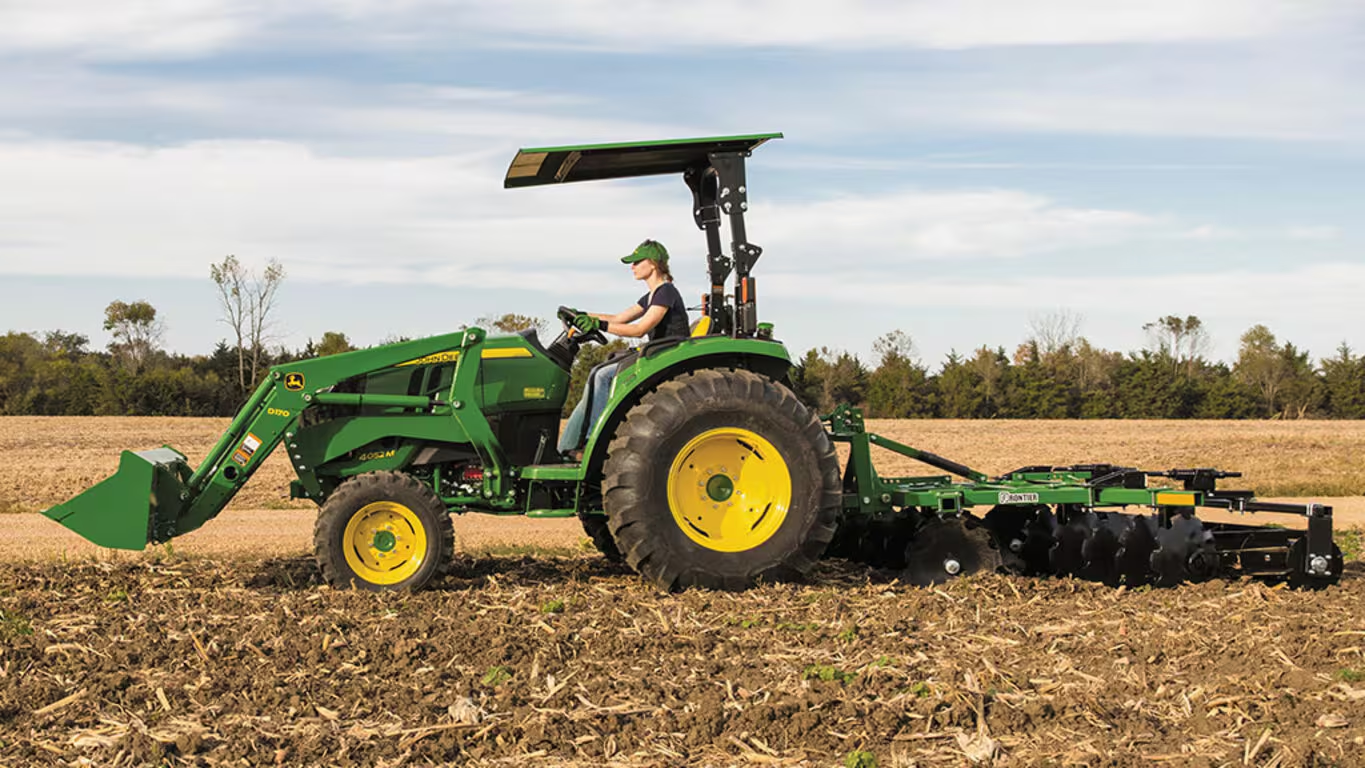
The John Deere 4052M is a tractor to evaluate around a mixed work calendar: cutting rough areas, maintaining a lane, moving materials and preparing for winter. Its position between the smaller and larger engines in the 4M range makes it tempting to call it the automatic compromise. That is not enough to choose it. The middle model earns its place only when the intended implements and operator requirements fit the actual configuration.
For Canadian buyers, three details deserve attention before negotiating a package: which transmission is fitted, what PTO information applies to it, and whether the open station suits the season. A fourth matters in used advertisements: the standard 4052M and the separately marketed 4052M Heavy Duty should not be treated as the same equipment list.
On This Page
ToggleThe verified specification base
| Item | 4052M Canadian page |
|---|---|
| Gross output | 37.9 kW / 50.8 hp / 51.5 PS |
| Engine | Four-cylinder, 2.091 L turbocharged Yanmar diesel |
| Transmission alternatives | 12F/12R PowrReverser; three-range eHydro |
| Implement flow | 42.3 L/min |
| Rear hitch rating | Category 1; 1,135 kg at 24 inches behind link arms |
| Operator station | Open station |
| PTO figure in detailed table | 29.2 kW / 39.1 hp; transmission attribution requires clarification |
Source: John Deere Canada’s 4052M page, checked October 1, 2026. Its detailed PTO entry and broader family descriptions are not consistent enough to assign one number to both transmissions. For a power-critical attachment, obtain serial- and transmission-specific documentation before committing. This guide does not silently replace the model’s table with a neighbouring tractor’s rating.
Start with a year of jobs, not one impressive demonstration
Make four seasonal rows on a sheet of paper. Put the recurring work in each row, then record the attachment and approximate frequency. This turns “general farm work” into something that can be evaluated. The tractor may spend most of its hours mowing even though the loader is what attracts attention during the sale.
For example, an owner might need weekly vegetation control in summer, several aggregate-moving jobs, autumn cleanup and winter access maintenance. The powered implement may set the engine requirement, while the loader attachment and lane geometry set other limits. The 4052M should pass each essential task separately rather than receiving a general approval because one task looks easy.
Give occasional but unavoidable jobs their own line. A heavy delivered pallet that must be unloaded several times a year can determine the handling solution even if it accounts for few hours. If that job exceeds the documented tractor-and-fork arrangement, plan a different delivery or handling method. More frequent light jobs do not cancel the requirement.
PTO-driven work: settle the rating before selecting width
Rotary cutters, tillers and blowers should be matched from their own requirements. First identify whether the manufacturer specifies engine horsepower or PTO horsepower. Then check the tractor version, implement mass, hitch arrangement and driveline. A cutting-width rule from an advertisement is not a substitute for these checks.
The documentation issue on this model matters most near an attachment’s minimum requirement. If the implement needs at least 40 PTO hp, an unqualified “about 40” statement is inadequate. Resolve the version-specific rating. If the combination cannot be documented, choose another implement or tractor configuration rather than assuming a slower travel speed approves it.
Once compatibility is established, workload still influences performance. Cutting maintained grass is a different job from reclaiming dense growth. Work rate also depends on overlaps, turning, obstacles and the finish required. A wider tool may offer little benefit if it is awkward around trees or cannot pass through the storage entrance.
Walk the area before choosing width. Mark narrow passages, turning areas and places where the implement would extend beyond a visible wheel track. This simple exercise can save more frustration than trying to optimise a horsepower number in isolation.
PowrReverser or eHydro for a mixed property?
For a day with many short loader movements, evaluate how easily the operator can approach, stop and reposition. For a day of longer passes, evaluate whether the available travel controls suit the required pace. The same person may prefer different arrangements for those jobs; the buying decision should reflect which routine dominates.
A useful demonstration includes the controls used most often, not just forward travel. Try the seating position with normal work boots, check reach to the loader control, and assess visibility while looking toward a rear tool. If more than one person operates the tractor, include each regular operator.
Do not attach a universal fuel-saving percentage to the transmission choice. A meaningful comparison would require similar work, conditions and measured consumption. The practical question is whether the selected version performs the required tasks comfortably within its instructions. Aglist’s transmission guide explains the terminology before a demonstration.
A loader package is more than loader arms
Establish the exact loader, attachment carrier, bucket or forks, hydraulic functions and required ballast on the quote. Deere’s 400E documentation includes this tractor. Its parking equipment also deserves attention if the loader must come off regularly; do not assume every used package includes it.
For loose materials, specify what is being moved and where it goes. Dense aggregate, mulch and bedding create different loading demands even in the same bucket. An attachment chosen for volume alone may be poorly suited to the heavier material on the property. Select the tool for the actual range of tasks and follow the approved loading instructions.
For deliveries on pallets, obtain the complete load weight and dimensions in advance. Placement height and forward reach matter as much as picking the load up. A demonstration with a light empty pallet cannot establish performance with the delivered goods. The relevant evidence is the applicable load information for the actual setup.
Consider the route between pickup and placement. Space beside a shed, ground condition and approach angle may determine whether the job is practical. It is often easier to alter the delivery location than to buy a tractor around an awkward and avoidable manoeuvre.
Separate standard 4052M equipment from Heavy Duty advertising
Deere lists the 4052M and 4052M Heavy Duty separately. The family page distinguishes their hitch equipment, including Category 1/2 and telescoping draft links on the Heavy Duty listing. Those details must not be copied into a description of a standard 4052M merely because the engine class looks similar.
When an advertisement is abbreviated, ask for identification and photographs of the actual hitch and controls, then reconcile them with the build information. This is especially useful when an implement collection comes with the tractor. Included equipment may reveal what the previous owner used, but it does not prove that every part of the combination was correctly matched.
Build a written inventory before assigning value. List the tractor version, tyres, loader, remotes, attachment carrier and every included tool. A clear inventory prevents comparisons between an extensively equipped machine and a bare tractor from becoming arguments about model names.
Lane maintenance and hydraulic equipment
A rear blade with hydraulic functions can demand more connections than a basic blade. Write down whether angle, tilt or offset must be adjustable from the seat, and identify a control for each required function. A total pump-flow figure does not establish how many circuits are present or how an attachment returns oil.
For a box scraper, examine the surface problem first. Is the objective to redistribute loose material, remove ridges or work a compacted patch? The tool and operating method should follow that answer. Tractor power alone will not correct a poorly chosen implement or a drainage problem outside the grading task.
Storage also affects the ownership experience. Leave enough space to attach the tool correctly and to approach its connection points. A crowded corner that requires repeated repositioning can make an otherwise capable tractor inconvenient every time the work changes.
Winter: evaluate exposure and attachment strategy together
The open station is an important limitation for some Canadian routines and entirely acceptable for others. Estimate how long the operator actually expects to work during a normal clearing event. Include opening gates, clearing around parked equipment and returning later for drifted areas. A quick pass along the centre of the lane may understate the real exposure.
If a blower is planned, check the complete installation rather than buying from engine horsepower alone. If pushing is planned, identify snow-storage areas before the season. If carrying snow is unavoidable, examine the route and loading arrangement. These are different equipment choices, not interchangeable uses of the same headline capacity.
A documented compatible enclosure may improve comfort, but should be evaluated separately from a factory cab tractor. If a heated cab is an essential requirement, put a suitable cab configuration on the shortlist from the beginning instead of assuming a later conversion will be straightforward.
Used inspection: concentrate on the actual machine
The product documentation describes exhaust aftertreatment. For a used tractor, obtain the correct maintenance information and have warning history and system condition assessed where appropriate. Do not infer that every warning proves major damage, or that an extinguished warning guarantees complete service. Ask for records and a qualified diagnosis.
Inspect the loader mounts, pivots, front axle, hitch, hydraulic connections and tyres as part of a broader operating assessment. Check repairs and modifications against the approved configuration. These are sensible inspection areas for a working compact tractor, not evidence of a model-specific failure pattern.
Keep the cost of identified work separate from purchase price. An inexpensive tractor with worn implements may still be a good project for one buyer and a poor match for someone who needs immediate dependable availability. That decision is easier when repair estimates are explicit.
How to compare the complete purchase
A John Deere 3046R may enter the shortlist for a different balance of platform and operator equipment. The New Holland Boomer 50 offers another model to investigate against the same task sheet. Neither comparison should be settled by rounding the engine output to the nearest ten.
Ask each quotation to show equipment price, implements, setup, delivery and financing separately. Include the hydraulic functions and attachment-change equipment needed from day one. Then compare support arrangements: service location, transport when repair is needed and availability of the wear parts used by your tools.
For planning, divide the package into essential equipment and later additions. An essential implement should not be postponed to make an unsuitable tractor appear affordable. Optional convenience equipment can be timed differently, provided the initial configuration already meets the work.
4052M FAQ
Is it automatically the best-value 4M?
No. The middle engine option is useful only if it meets a requirement the smaller alternative does not, without paying for capability the work never uses.
Why is the PTO number qualified?
The current Canadian page does not label the detailed rating consistently across its transmission descriptions. A power-critical purchase needs the correct version’s documentation.
Does a Heavy Duty listing describe a standard 4052M?
No. Verify the tractor identity and installed equipment. Similar names do not establish identical hitch or control arrangements.
Should I choose it for pallet deliveries?
Only if the complete loader-and-fork configuration is documented for the actual load and placement task. Engine output is not a pallet rating.
What should settle the decision?
A complete seasonal work plan, verified implement compatibility and a quotation that includes the equipment needed to perform those jobs.
Share your experience
Help other Canadian buyers — leave a quick review for the
John Deere 4052M
There are no reviews yet. Be the first one to write one.