Overview & Specs
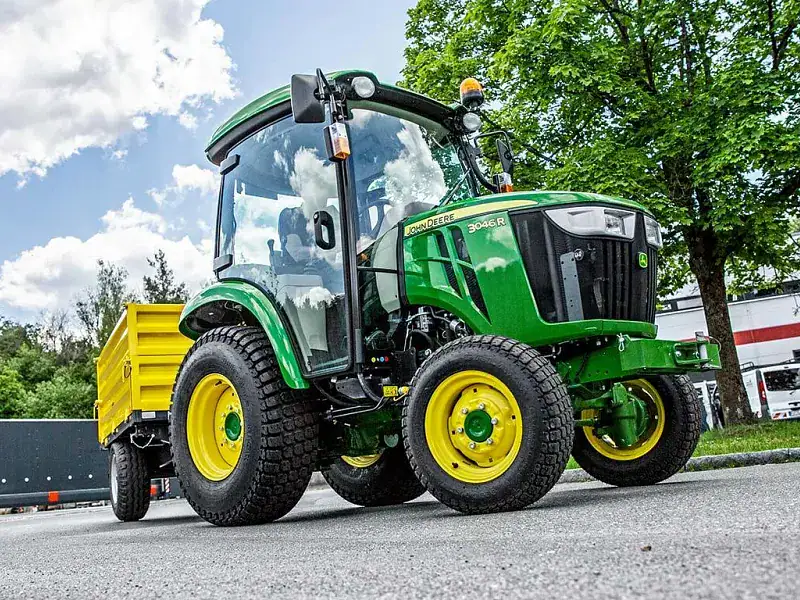
The John Deere 3046R is a compact tractor to investigate when sustained PTO work, hydrostatic control and the option of an enclosed operator station belong in the same purchase. Its extra engine output can be useful, but it does not mean every part of the tractor gains proportionally more capacity. Buyers should separate the power requirement from loader limits, rear-tool geometry and the value of the chosen cab and controls.
For a Canadian owner working across seasons, that creates a more useful question than whether the 3046R is the biggest model on a shortlist: which recurring job needs this particular package? This guide uses the Canadian product information checked on September 30, 2026, with configuration differences kept explicit.
On This Page
Toggle3046R specifications: power and configuration
| Item | Published Canadian specification |
|---|---|
| Gross engine output | 33.3 kW / 44.7 hp |
| PTO output | 33.9 hp |
| Engine | Approximately 1.57 L, three-cylinder turbocharged and intercooled Yanmar diesel |
| Transmission | Three-range eHydro |
| Implement hydraulic flow | 34.3 L/min / 9.1 US gpm |
| Category 1 hitch lift | 995 kg / 2,194 lb at 24 inches behind link arms |
| Approximate shipping weight | Open station: 1,391 kg / 3,066 lb; cab: 1,818 kg / 4,008 lb |
Source: John Deere Canada’s 3046R page. These are published configuration figures, not the weight or capacity of a fully equipped tractor carrying an unspecified attachment.
When the extra output has a job to do
The power case starts with a named implement. A tool’s requirement may refer to engine output or PTO output, and that distinction must be resolved before comparing tractors. Record the implement’s intended duty, weight, hitch arrangement and operating requirements alongside its power specification.
For a hypothetical tool requiring a minimum of 32 PTO hp, the rating above passes the initial power screen. That does not approve the complete combination. Mounting, driveline, ballast and the tool’s remaining requirements still need to fit. A hypothetical tool requiring 40 PTO hp would lead to a different investigation, regardless of the tractor’s gross engine number.
It is also possible for a less powerful tractor to meet your entire tool list. In that case, evaluate whether the additional output changes a recurring task under representative conditions. Do not assign it an invented fuel saving or assume it will reduce every job by the same percentage.
3046R versus 3039R: separate power from the rest of the platform
Deere’s 3039R specifications list the same implement-flow and rear-hitch figures shown above, while offering a different transmission choice. That makes the comparison more specific than “larger model equals more of everything.”
If the reason for upgrading is a rear tool’s power requirement, compare the transmission-specific PTO ratings. If the reason is lifting, investigate the approved loader or hitch arrangement. If the reason is an operator feature, compare the actual build. These are different purchase arguments and should not be merged into a single horsepower comparison.
A useful side-by-side quotation lists the equipment that remains the same and the capability that changes. If your planned attachment and daily handling requirements are unchanged, the larger engine needs a clear role in the work or a consciously chosen reserve—not a vague promise that the whole machine will be stronger.
eHydro controls: evaluate what they change in the work
Deere describes LoadMatch as reducing travel speed as load demand rises, SpeedMatch as a travel-speed limit function and MotionMatch as an adjustment to travel response. These functions support control of the work; they do not increase the tractor’s approved attachment or handling limits. Their operation and settings belong to the machine’s manual.
For a purchasing demonstration, identify the difficulty you want a control feature to address. Is it maintaining a suitable feed into a PTO tool, repeatedly approaching a placement point or achieving a consistent travel response? Ask for the function to be demonstrated in that context, with the regular operator and appropriate procedures.
Keep the assessment concrete. “Easier to hold an appropriate pace through this section” is a useful observation. “The electronics make every operator more productive” is not a conclusion a short demonstration can support. If several people share the tractor, allow each to assess seat position, pedal reach and visibility.
Engine-speed features also need to be understood in relation to PTO work. The tool requires its specified shaft conditions, while travel determines the rate at which work is presented to it. A convenient travel response does not remove the need to select the appropriate range and operating settings.
A cab changes the ownership calculation
The cab decision is about the working season, the operator and the complete machine. A property owner doing short summer tasks has a different requirement from an operator clearing snow before daylight or spending extended periods around dust and wind. Compare the time and conditions in which the enclosure will actually be used.
During inspection, test the relevant climate and visibility functions. Look at the view of the loader attachment and the rear implement from the working position. Wear normal work clothing and check access, seat adjustment and control reach. A comfortable showroom sit does not necessarily reveal the movements required while watching a rear tool for a long pass.
Measure the storage opening with the actual cab, tyres and accessories. A cab tractor cannot be evaluated using an open-station clearance assumption. Include lights, door movement and any overhead obstacle in the storage route, and use the manufacturer’s instructions for the configuration.
The mass difference also belongs in the transport plan. Neither published shipping figure includes an assumption that the loader, ballast and carried tools are absent from the trailer. Assemble the real transport manifest and verify the whole hauling combination rather than choosing whichever bare-tractor number fits an existing plan.
Loader selection: do not buy from a single headline capacity
The 320R loader is identified by Deere for the 3R family. Its public detailed specification table references a different tractor and contains values that do not align cleanly with the headline. Obtain configuration-specific loader information for the 3046R instead of treating that web table as a verified fork load chart.
For a load-handling task, gather the complete load, attachment identity, load centre and required height. Establish the permitted arrangement and ballast from the relevant documentation. More engine power is not a reason to exceed a loader or axle limit.
For loose materials, select the bucket around the material and job. Volume alone does not describe load weight. For loading a receiver, check discharge clearance and reach using the actual bucket. The loader pivot’s maximum height does not establish that the tipped bucket clears a particular trailer side.
Consider the value of loader removal if mowing or other tasks regularly follow material work. Evaluate the approved parking arrangement and available storage space. A quick-removal feature is useful when it fits the routine; it should not be valued as a time saving that no one has measured.
Rear tools: build a compatibility register
For each implement, keep the model, weight, power requirement, hitch arrangement, driveline information and hydraulic functions in one place. This is particularly useful when buying several tools at once: it makes missing connections or incompatible assumptions easier to spot.
Separate the rear hitch’s ability to raise a tool from the tool’s power requirement and from the tractor’s ability to work with it in the intended conditions. A long attachment may create access and handling questions even when its mass is below a headline hitch figure. Use the specified measurement location when comparing capacities.
If a mid-mounted or front-driven implement is part of the plan, identify the complete PTO, mounting and drive package. Do not assume a tractor advertised with one compatible attachment is already equipped for another. The written quotation should name the required equipment, not merely say “attachment ready.”
Canadian work scenarios that can justify this package
Repeated PTO work with changing conditions
A property with recurring mowing or soil work may benefit from selecting power and travel controls together. Demonstrate the chosen implement in representative material and assess the acceptable finish, not only the apparent speed. Record the conditions and operator so the result remains a useful observation rather than a universal productivity claim.
Year-round maintenance
Where the tractor works through winter, compare the snow-handling method and operator environment early. Identify where snow will be pushed, stored or discharged and verify the actual attachment. Aglist’s snowblower fitment guide helps separate mounting, PTO and hydraulic questions.
Several operators and frequent changes of task
A more equipped compact can be attractive when multiple operators need a consistent setup and tools change regularly. Evaluate control familiarity, attachment storage and the documented changeover process. The business case should describe the repeated inconvenience being solved, rather than simply count the number of available features.
What to compare before moving to a larger tractor class
Aglist’s 2038R overview is relevant when a different compact attachment arrangement may cover the work. The Kubota L3902 and Workmaster 35C provide other compact starting points, subject to current configuration checks.
If the essential task demands a substantially different loader envelope, heavier rear equipment or capability beyond this configuration, revisit the machine class. The tractor size guide can help structure that decision. A well-equipped compact is not automatically a replacement for a utility tractor or a dedicated material handler.
Do not let the most dramatic occasional task erase the rest of the year. Price a suitable rental or another method for genuinely occasional work where practical. Conversely, an essential daily task outside the approved capability cannot be averaged away by the many easier jobs the tractor handles.
Used-machine inspection and a realistic budget
Confirm serial identity, operator station, PTO equipment, hydraulic functions and included attachments. Have a qualified person inspect relevant drivetrain operation, hydraulic functions, loader mounting and linkage, front axle, hitch, tyres and repair evidence. Check the fitted cab systems rather than assigning their full value from the advertisement.
Review service history with the appropriate manuals and obtain estimates for identified repairs. These are general inspection priorities, not a list of alleged recurring 3046R faults. Inspect each included implement as a separate asset, including wear parts, guards and compatibility.
Compare itemised equipment prices, finance terms, delivery, required setup, service and wear items. Add the cost of any transport or storage changes. A lower monthly payment may result from different terms or missing equipment, while a more expensive package may contain features irrelevant to your workload.
Finally, test the estimate at a quieter year as well as expected use. Fixed costs do not disappear when hours fall. Use local quotations and your own task records rather than an invented Canadian purchase price, fuel rate or resale premium.
3046R buyer questions
Does the larger engine mean a proportionally stronger loader?
No. Loader capability must be established from the approved tractor, loader and attachment configuration.
Should I use gross horsepower to choose a PTO implement?
Only if the implement explicitly specifies engine power. Otherwise use the required rating type, including the separate PTO figure where applicable.
Do electronic travel controls replace operating limits?
No. They assist control of the work and do not change capacity, attachment compatibility or the procedures in the manuals.
Is a cab mainly a comfort extra?
Its value depends on the actual working season and operator needs. It also changes clearance, weight and the equipment that must be inspected and maintained.
When is the 3046R the wrong upgrade?
When the unresolved problem is access, a different loader requirement or an incompatible attachment rather than usable power and equipment features. Identify that constraint before paying for the larger engine package.
Share your experience
Help other Canadian buyers — leave a quick review for the
John Deere 3046R
There are no reviews yet. Be the first one to write one.