
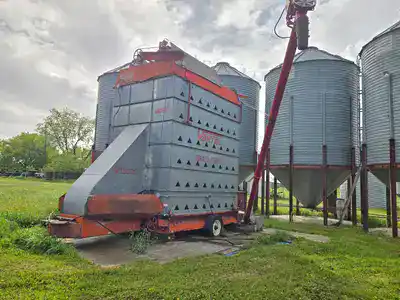

Few grain dryer brands are as woven into the Canadian prairie harvest as Vertec. Designed and built in Vermilion, Alberta — originally by Vertec Industries Ltd. and later carried under the IBEC/Vertec name — these continuous-flow dryers have moved millions of bushels of wheat, barley, canola, and corn across Saskatchewan, Alberta, and Manitoba for four decades. They aren’t built new in volume anymore, but that’s exactly why they matter to so many Canadian farmers today: the used market is thick with them, parts and service support is alive and well, and a well-kept Vertec remains one of the most cost-effective ways onto a continuous-flow drying system.
This guide is built for the two people who search “Vertec grain dryer” in Canada: the farmer weighing a used Vertec against a new dryer, and the existing owner looking for specs, capacities, parts, and straight talk on what these machines do well and where they show their age. We cover the full model range as it actually appears on the prairie used market, anchor the performance discussion in independent Prairie Agricultural Machinery Institute (PAMI) test data, and point you to the parts and retrofit support that keeps these dryers running. No sales pitch — just what a Vertec is, what it’s worth, and whether one belongs on your farm.
The Vertec Lineup at a Glance
Vertec dryers are named by a size code (the “VT” number) and configured by the number of drying tiers and openings. Larger numbers and more tiers mean more capacity. Here is the range as it appears across Canadian used listings and auction records, with the data-confidence level flagged honestly — because spec sheets for forty-year-old prairie dryers vary by model year and configuration.
| Model | Type | Tiers | Approx. Capacity | Burner | Data Confidence |
|---|---|---|---|---|---|
| Vertec VT5600 / VT5600R | Continuous multi-flow | 6 | ~334 bu/h wheat (5% removal, PAMI) | Propane / NG | Verified (PAMI tested) |
| Vertec VT5500 | Continuous multi-flow | 5 | Mid-size, ~3.5M BTU class | Propane / NG | Used-listing data |
| Vertec VT6600 | Portable continuous | 6–9 (config) | ~600 bu/h class (config-dependent) | Propane / NG, ~4–6M BTU | Used-listing data |
| Vertec VT8600 | Continuous flow | 6 | ~1,800 bu/h class | NG, ~6M BTU | Used-listing data |
| Vertec VT4000 | Continuous multi-flow | smaller frame | Smaller capacity | Propane / NG | Limited data |
| Vertec VT2000 | Continuous multi-flow | smallest | Smallest in range | Propane / NG | Limited data |
The VT4000 and VT2000 are the older, smaller machines in the family — they turn up on the used market but reliable published specifications are scarce, so we’ve listed what’s known rather than publishing numbers we can’t stand behind. The four linked models above have enough verifiable data to support full model pages, with the VT5600R standing on independent PAMI test results — the strongest data any grain dryer page on Aglist carries.
One naming note that trips up used buyers: capacity claims in listings are quoted at different moisture-removal levels and crops, so a “600 bu/h” Vertec and an “1,800 bu/h” Vertec aren’t always being measured the same way. Always confirm the crop and the points of moisture removal behind any capacity number — a point we return to throughout this guide.
What a Vertec Actually Is: Continuous Multi-Flow, Screenless
The Vertec is a continuous multi-flow grain dryer. Grain loads into a wet-holding section at the top, then flows down through vertical grain chambers past alternating hot-air and cool-air plenums. A fan forces ambient air either past the burner into the hot-air plenum or directly into the cool-air plenum; the air passes through ducts in the grain column to dry, then cool, the grain. Variable-speed metering rolls at the bottom control how fast grain moves through, and dry grain discharges continuously from the base.
The defining design trait — and a genuine ownership advantage — is that Vertec dryers are screenless. There are no perforated screens to plug with chaff, fines, or canola. The PAMI evaluation specifically rated ease of cleaning as excellent for exactly this reason: troughs swing down, plenums clear out easily, and there’s no screen-blinding to fight. For prairie operations drying dusty cereals and canola, a screenless design is one less maintenance headache during a hard run.
The trade-off versus a modern tower or mixed-flow dryer is automation and per-hour throughput. A Vertec is a mechanically straightforward machine: metering-roll speed and a modulating burner valve, monitored at a simple control panel. The original machines were not built around the touchscreen moisture-control automation that defines new dryers — though, importantly, many prairie Vertecs have since been retrofitted with modern moisture controllers and burner upgrades, which narrows that gap considerably (covered in the parts and service section below).
PAMI Test Data: Real Vertec Performance Numbers
This is where a Vertec earns genuine credibility that newer, unproven machines can’t claim: it was independently tested by the Prairie Agricultural Machinery Institute, the prairie’s own machinery evaluation body. PAMI Evaluation Report 289 put a Vertec VT5600R through 120 hours drying roughly 30,000 bushels across four crops, at standardized conditions that allow honest comparison. The headline results:
- Wheat: rated drying capacity ~334 bu/h at 5% moisture removal
- Barley: ~372 bu/h at 5% removal
- Canola (rapeseed): ~163 bu/h at 5% removal
- Corn: ~209 bu/h at 10% removal
PAMI also measured fuel and energy use: in wheat, specific fuel consumption worked out to roughly 7.4 gal of propane per 100 bushels, and the dryer’s grain-drying temperature uniformity was rated very good. No grade losses occurred when drying commercial wheat and canola or feed barley and corn at the manufacturer’s recommended settings. The full crop-by-crop breakdown — including fuel curves, energy consumption, and the durability and safety findings — lives on the Vertec VT5600R model page.
Why this matters for a buyer: these are measured, independent, prairie-tested numbers, not brochure claims. They give you a realistic capacity baseline for the most common Vertec on the market, and they let you sanity-check the capacity figures in any used listing. If a seller claims a VT5600 does far more than PAMI measured, ask what crop and moisture removal they’re quoting. PAMI test data is the kind of independent E-E-A-T evidence that separates a real evaluation from a sales sheet — and it’s exactly why we anchor the Vertec cluster on it.
Reading the Used Vertec Market in Canada
Because Vertec dryers aren’t built new in volume, essentially the entire market is used — and it’s an active one across the prairies. Typical Canadian listings on Kijiji, AgDealer, MarketBook, and farm auctions run roughly CAD $10,000–$40,000 depending on model, tier count, burner condition, fuel type, controls, and whether the machine has been updated. As reference points from recent listings: a 5-tier VT5500-1S with an updated burner has listed around CAD $29,700, and a 6-tier VT8600 around CAD $39,300.
What to inspect on any used Vertec, in priority order:
- Burner and fuel system condition — the burner is the heart of the machine. Updated/linear burners and Maxon retrofits are a real plus; an original, tired burner is a future cost. Confirm propane vs natural gas and whether it’s been converted.
- Tier and plenum integrity — look for corrosion, warped sheet, and air leaks at the plenum corners. Higher garner sides (a later improvement) reduce air escape.
- Metering rolls and drives — check the metering-roll drive and the cross-auger belt (PAMI noted a cross-auger belt failure in testing; it’s a known wear point). Extruded aluminum metering rolls are an upgrade over originals.
- Controls — has it been retrofitted with a modern moisture controller (e.g., Dryer Master) or a NECO Commander system? Automation dramatically changes day-to-day usability and resale value.
- Phase and power — single-phase vs three-phase (some run 600V), and PTO-drive vs electric-motor drive. Match this to what your yard can actually supply.
The smart-money view: a clean, updated Vertec — modern burner, moisture controller, sound tiers — is frequently the lowest-cost route onto a continuous-flow system for a mid-size prairie farm. A neglected one with an original burner and no automation is a project. The price gap between the two is usually smaller than the cost to bring the project machine up to spec, so condition matters more than the sticker.
Parts, Service & Retrofit Support
A legitimate worry with any legacy dryer is “can I still get parts and keep it running?” For Vertec, the answer is genuinely yes — and this is a major reason the machines hold value on the prairie. A network of Canadian specialists supports Vertec, IBEC, and similar screenless dryers with parts, repairs, and modernization:
- Burner upgrades — fuel-efficient Maxon burners (6 and 7.5 million BTU output) and LPG vaporizers are available as retrofits, improving both efficiency and reliability over original burners.
- Tier and roof kits — expansion tiers (12′, 16′, 24′) and enclosed gravity-fill roof assemblies with catwalks fit Vertec, IBEC, Phoenix, Grain King, and Grain Handler mixed-flow dryers, letting owners add capacity.
- Controls modernization — Dryer Master moisture systems and factory-built NECO Commander control/fuel systems can be fitted, bringing automated moisture control to a forty-year-old frame.
- Drive conversions — PTO-fan-drive to electric conversions, and single-phase to three-phase variable-speed drives (VFDs), modernize the power side.
- Wear parts — extruded aluminum metering rolls and shafts, level switches, and clean-out door kits keep the grain-handling side serviceable.
The practical takeaway: a Vertec is not an orphan. Between specialist service shops and the broad parts commonality across prairie screenless dryers, these machines can be kept running — and meaningfully upgraded — for years. That serviceability is a core part of the value argument for buying used.
Vertec vs Modern Tower & Mixed-Flow Dryers
How does a used Vertec stack up against a new dryer? Honestly, on different terms. A modern tower dryer like the GSI 2300-series or a current mixed-flow machine delivers higher per-hour throughput, touchscreen moisture automation, and remote monitoring straight from the factory — at new-equipment prices that run several times a used Vertec. A portable continuous dryer like a Super-B SQ-series machine offers modern controls and easy farm-to-farm mobility in a new package.
The Vertec’s case is value and proven simplicity. For a farm whose drying volume fits the Vertec’s measured capacity, a clean updated machine does the core job — take tough grain down to a storage-safe moisture, screenless and serviceable — at a fraction of new-dryer cost. Where a Vertec falls behind is sustained high-volume throughput and hands-off automation: if your harvest window is tight and your daily intake is large, a new high-capacity tower or mixed-flow dryer will keep up where a Vertec becomes a bottleneck.
The deciding questions are throughput and automation appetite. Match your real daily wet-bushel intake against the PAMI-measured capacity, decide how much you value touchscreen automation versus mechanical simplicity, and the answer usually makes itself clear. For the full new-dryer landscape, see our Best Grain Dryers in Canada guide and the complete grain dryer category.
Which Vertec Fits Your Operation
Smaller mixed grain farm, moderate daily intake, value-first — a clean VT5500 or VT5600/VT5600R. The PAMI-tested VT5600R is the best-documented machine in the range, and at used prices it’s a proven, screenless, serviceable entry onto continuous-flow drying. See the VT5600R page.
Operation wanting more capacity in a portable package — the VT6600, configured with more tiers. Portable continuous design suits farms that move the dryer or want flexible siting.
Higher-throughput need, three-phase power available — the VT8600, the largest common Vertec, with the highest capacity class in the family. Confirm your yard can supply the power it needs.
Owner of an older VT4000 or VT2000 looking to keep it running — focus on the parts and service section above; burner and control retrofits can modernize these older frames cost-effectively, and tier commonality keeps parts available.
Tight harvest window, large daily volume, want automation out of the box — a Vertec may become a bottleneck. Compare new tower and mixed-flow options in our grain dryer category and Best Grain Dryers guide.
For sizing any dryer against your real harvest throughput, the Grain Dryer Sizing Calculator helps match capacity to daily wet-bushel intake — the single most important number in choosing a dryer.
Frequently Asked Questions
Are Vertec grain dryers still made?
Not in volume. Vertec was designed and built in Vermilion, Alberta (Vertec Industries Ltd., later under the IBEC/Vertec name), and the machines you’ll find today are on the used market. However, parts, burner upgrades, control retrofits, and full service support remain available through Canadian specialists, so the dryers are very much still in active use across the prairies.
How much grain can a Vertec dryer handle?
It depends on the model, crop, and moisture removal. Independent PAMI testing of a VT5600R measured about 334 bu/h in wheat and 372 bu/h in barley at 5% moisture removal, and about 209 bu/h in corn at 10% removal. Larger models like the VT8600 are quoted in the ~1,800 bu/h class in used listings. Always confirm the crop and points of moisture removal behind any capacity figure, since listings quote them differently.
What does “screenless” mean and why does it matter?
Vertec dryers use a continuous multi-flow design with no perforated screens. That means nothing for chaff, fines, or canola to plug, which makes cleaning far easier — PAMI rated the VT5600R’s ease of cleaning as excellent. For dusty prairie cereals and canola, screenless is a real maintenance advantage during a hard drying run.
Is a used Vertec a good buy in Canada?
For the right farm, yes. A clean, updated Vertec — modern burner, moisture controller, sound tiers — is one of the lowest-cost ways onto a continuous-flow drying system, and parts and service support keep it viable. A neglected machine with an original burner and no automation is more of a project; the cost to bring it up to spec often exceeds the price gap to a better-kept unit, so buy on condition, not just price.
Can I get parts for a Vertec dryer?
Yes. Canadian specialists supply burner upgrades (Maxon 6 and 7.5M BTU), tier and roof expansion kits, Dryer Master and NECO Commander control retrofits, PTO-to-electric and single-to-three-phase drive conversions, metering rolls, level switches, and clean-out kits. Parts commonality across prairie screenless dryers (Vertec, IBEC, Phoenix, Grain King, Grain Handler) keeps these machines serviceable.
What’s the difference between a Vertec and a modern tower dryer?
A modern tower dryer offers higher per-hour throughput and touchscreen moisture automation from the factory, at several times the cost of a used Vertec. The Vertec is a simpler, screenless, mechanically straightforward continuous-flow machine whose strength is value and proven reliability for farms whose volume fits its measured capacity. Throughput need and automation appetite decide between them.
Did PAMI test Vertec dryers?
Yes. The Prairie Agricultural Machinery Institute published Evaluation Report 289 on the Vertec VT5600R, testing it over 120 hours across wheat, barley, canola, and corn with measured capacity, fuel consumption, energy use, drying-temperature uniformity, durability, and safety findings. It’s one of the few grain dryers on the Canadian used market with independent prairie test data behind it — the full breakdown is on our VT5600R model page.
Note: We try our best to keep specs and information accurate, but some details can be missing or different depending on the source, model year, or configuration. Vertec dryers span decades of production and many have been retrofitted, so individual machines vary. Verified performance figures on this page come from PAMI Evaluation Report 289 (VT5600R); other capacity figures are drawn from used-market listings and should be confirmed with the seller. Before you buy, service, or repair equipment, double-check key specs with the seller, a qualified dryer service shop, or the owner’s manual.
About reviews: Reviews on Aglist are written by real users. We moderate them for spam and abuse, but opinions and claims are still personal — so use them as guidance, not as a guarantee.
