
Overview & Specs
Vertec VT5600R Grain Dryer Review, Specs & PAMI Test Data — Canada Guide
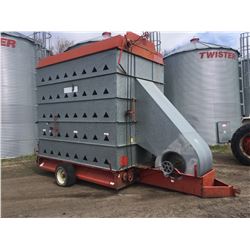
The Vertec VT5600R is the best-documented dryer in the entire Vertec range, and one of the very few grain dryers on the Canadian used market with independent prairie test data behind it. Designed and built in Vermilion, Alberta, it’s a 6-tier continuous multi-flow, screenless dryer that the Prairie Agricultural Machinery Institute (PAMI) put through a full 120-hour evaluation across wheat, barley, canola, and corn. That makes this page different from almost anything else you’ll find on a used Vertec: instead of brochure claims or a single auction listing, the performance numbers here come from a standardized, independent test — measured capacity, fuel consumption, energy use, and durability findings across four prairie crops.
This guide is built for two Canadian readers: the farmer evaluating a used VT5600R against other dryers, and the existing owner who wants real specs, capacity figures, and an honest read on what this machine does well and where it shows its age. Imperial units lead, with metric alongside, and everything traces back to PAMI Evaluation Report 289 or current Canadian used-market data.
Aglist quick take: The VT5600R is the proven, PAMI-tested heart of the Vertec range — a screenless 6-tier continuous-flow dryer measured at ~334 bu/h in wheat (5% removal). Its strengths are simplicity, excellent cleanability, and independent test credibility that newer machines can’t claim. Where it shows its age: mechanical (not touchscreen) controls and modest per-hour throughput versus modern towers — though burner and moisture-control retrofits close much of that gap. For a mid-size prairie farm buying on value, a clean updated VT5600R is hard to beat.
On This Page
ToggleQuick Verdict — Who the VT5600R Is For
Buy it if: you run a small-to-mid-size mixed grain farm, your daily wet-bushel intake fits its measured capacity, and you want a proven, screenless, serviceable continuous-flow dryer at used-market value. The PAMI test data gives you a realistic capacity baseline, parts and retrofit support keep it viable, and a well-updated example does the core drying job for a fraction of new-dryer cost.
Skip it if: you have a tight harvest window with large daily volume (a modern high-capacity tower or mixed-flow dryer will outpace it), or you want touchscreen moisture automation and remote monitoring out of the box without retrofitting. A neglected VT5600R with an original burner and no controls upgrade is a project, not a bargain.
1. Full Vertec VT5600R Specifications
The specifications below come from PAMI Evaluation Report 289, which tested a 1979-model VT5600R. Configurations vary by model year and retrofits, so confirm details on any specific machine.
| Category | Spec | Value |
|---|---|---|
| Type | Dryer design | Continuous multi-flow, screenless |
| Grain chambers | 2 vertical columns, 6 layers (tiers) | |
| Manufacturer | Vertec Industries Ltd., Vermilion, Alberta | |
| Burner | Maximum rating | 3.9 GJ/h (~3.7M BTU/h) |
| Type | Propane, spark ignition | |
| Fan | Type | Forward-curved centrifugal |
| Speed | 550–600 rpm | |
| Drive | Belt from electric motor or PTO | |
| Holding capacity | Wet grain section | ~19.1 m³ (525 bu) |
| Metering | Device | Variable-speed metering rolls (4) |
| Speed range | 0–18 rpm | |
| Max grain flow | ~825 bu/h through metering rolls | |
| Electrical | Control circuit | 115 V AC, single phase |
| Motor (tested) | 11.2 kW (15 hp), 230 V AC, 3-phase | |
| Single-phase option | Available | |
| Transport | Width | 3.13 m (10.2 ft) |
| Height | ~4.8 m (15.7 ft) | |
| Tow speed (tested) | up to 40 km/h (25 mph) | |
| Weight | Empty | 3,611 kg (~7,960 lb) |
| Sound level | At control panel | 69 dBA |
| Certification | CGA (Canadian Gas Association) certified | |
| Instruments | Fuel pressure gauges, drying-temp gauge, safety shutdown light |
Source: PAMI Evaluation Report 289 (Vertec VT5600R, 1979 model). Later model years included improved burners, higher garner sides, higher-rated tires, and optional electronic moisture control — confirm the configuration of any specific used machine.
2. PAMI Test Results: Capacity, Fuel & Energy
This is the section no competitor can match — independent, standardized capacity and efficiency data from the prairie’s own machinery institute. PAMI operated the VT5600R for 120 hours, drying about 30,000 bushels (733 tonnes) across four crops, and adjusted all results to standard drying conditions so they can be compared fairly against other tested dryers.
Rated drying capacity (the capacity while removing 5% moisture in cereals/canola, 10% in corn):
| Crop | Rated capacity | Moisture removed |
|---|---|---|
| Wheat | ~334 bu/h (9.1 t/h) | 5% |
| Barley | ~372 bu/h (8.1 t/h) | 5% |
| Canola (rapeseed) | ~163 bu/h (3.7 t/h) | 5% |
| Corn (Hybrid 3996) | ~209 bu/h (5.3 t/h) | 10% |
Fuel consumption at rated capacity:
| Crop | Per 100 bu | Per hour |
|---|---|---|
| Wheat | ~7.4 gal propane | ~24.6 gal/h |
| Barley | ~6.3 gal propane | ~23.5 gal/h |
| Canola | ~5.0 gal propane | ~8.1 gal/h |
| Corn | ~13.8 gal propane | ~28.8 gal/h |
Quality and uniformity: PAMI found no grade losses when drying commercial wheat and canola, or feed barley and corn, at the manufacturer’s recommended settings. Grain-drying temperature uniformity was rated very good, with low temperature variation in the hot-air plenum across all four crops. Grain cooling was good and easy to adjust, and ease of cleaning was rated excellent thanks to the screenless design.
How to use these numbers: they’re your reality check on any used VT5600R. Wheat and barley are the machine’s strongest crops; canola throughput is naturally lower (less moisture, finer seed); corn demands the most fuel per bushel because of the 10% removal. If a seller quotes a capacity far above these figures, ask which crop and how many points of moisture removal — the difference between a 5% and a 10% removal claim is enormous.
3. Owner Reviews & Ratings on Aglist
The VT5600R has decades of prairie field history, so the owner base is deep. As Canadian owners share their experience on Aglist, the rating system tracks:
- Reliability — burner performance, drive durability, uptime through harvest
- Capacity — real throughput on your crops vs the PAMI baseline
- Fuel efficiency — propane/NG use in your conditions
- Ease of operation — controls, metering adjustment, cleanout
- Serviceability — parts availability, retrofit experience
If you own or have run a VT5600R in Canada — original or retrofitted with a modern burner and moisture controller — please leave a star rating and a short note in the form below. Owner data on legacy dryers is genuinely scarce online, and your experience helps the next prairie buyer.
4. How the VT5600R Compares
The VT5600R sits in the mid-size continuous-flow class on the used market. Here’s how it frames up against the other documented Vertecs and modern alternatives.
| Spec | Vertec VT5600R | Vertec VT8600 | GSI 2318 | Super-B SQ16 |
|---|---|---|---|---|
| Type | Continuous multi-flow | Continuous flow | Tower continuous | Portable continuous |
| Tiers | 6 | 6 | n/a (tower) | n/a |
| Capacity class | ~334 bu/h wheat (5%) | ~1,800 bu/h class | Higher (modern tower) | Modern portable |
| Controls | Mechanical (retrofit avail.) | Mechanical (retrofit avail.) | Touchscreen automation | Modern controls |
| Screenless | Yes | Yes | — | — |
| Market | Used only | Used only | New + used | New + used |
| Test data | PAMI 289 | — | — | — |
Where the VT5600R wins: independent PAMI test credibility, screenless low-maintenance design, excellent cleanability, mechanical simplicity, and the lowest cost of entry onto continuous-flow drying. Strong prairie parts and service support.
Where it loses: lower per-hour throughput than the larger VT8600 or a modern tower, and mechanical rather than touchscreen controls in original form. For large daily volumes or hands-off automation, newer machines lead — see the Vertec hub for the full range and the grain dryer category for modern options.
5. Real-World Performance
Drying & Capacity
The VT5600R’s measured ~334 bu/h in wheat and ~372 bu/h in barley (at 5% removal) make it a capable mid-size dryer for a farm whose daily intake fits that range. Canola runs slower at ~163 bu/h, which is normal for the crop. The continuous multi-flow design moves grain steadily down through six tiers past hot and cool plenums, discharging dry grain continuously — well-suited to steady harvest intake rather than batch-by-batch work, though it can run as a batch dryer if needed.
Burner & Fuel
The original spark-ignited propane burner performed well across conditions in PAMI testing, though it burned erratically when drying corn at low ambient temperatures (optional equipment addressed this). Fuel efficiency was solid for the era — ~7.4 gal/100 bu in wheat. Many prairie VT5600Rs have since been fitted with modern Maxon burners, which improve both efficiency and cold-weather reliability over the original.
Cleaning & Serviceability
This is a standout. The screenless design earned an excellent cleanability rating from PAMI: troughs swing down, plenums clear easily, and there are no screens to blind with fines or canola. For dusty prairie drying, that’s a real day-to-day advantage. Lubrication points were accessible and easy to service.
Controls & Operation
Original controls are mechanical — metering-roll speed via a variable-speed drive lever, drying temperature via a modulating valve screw, monitored at a simple panel. PAMI noted the metering-roll adjustment was sensitive (small lever movements produced large speed changes), which is a learning curve. Later electronic moisture controllers — and modern retrofits like Dryer Master — automate metering-roll speed to hold a target moisture, a worthwhile upgrade on any used machine.
6. Common Problems & Reliability Notes
Transparency note: these notes combine PAMI’s durability and safety findings with the realities of buying a decades-old machine. Condition varies enormously by machine and retrofit history — always inspect before buying.
Cross-auger belt wear. PAMI’s test unit broke the rear cross-auger drive belt once during 120 hours. It’s a known wear point — inspect the belt and keep a spare.
Original burner cold-weather behaviour. The original burner could burn erratically drying corn below 0°C without optional equipment. A modern Maxon burner retrofit largely resolves this — check whether the machine has been updated.
Metering-roll adjustment sensitivity. Original variable-speed metering control is touchy; small movements make big flow changes. A moisture-controller retrofit removes this pain point.
Plenum air escape on early units. Earlier machines could lose air at the upper plenum corners; higher garner sides (a later standard improvement) fixed this. Check for air leaks and whether the fix is present.
Tire load ratings on original machines. PAMI flagged that the original tires exceeded their rated load — later dryers got higher-rated tires. On an old unmodified unit, check the tires before transport.
Age-related everything. These are 25–45-year-old machines. Burner condition, sheet-metal corrosion, drive belts, bearings, and controls all depend on care and retrofits. The good news: parts and retrofit support remain available (see the Vertec hub parts section).
7. Price Range in Canada (Used)
The VT5600/VT5600R is sold exclusively used. Canadian listings and auction results vary widely with burner condition, controls, fuel type, drive, and overall state.
- Project / original-condition units: typically CAD $8,000–$18,000 — older burner, mechanical controls, work needed
- Good updated units: typically CAD $18,000–$30,000 — modern burner and/or moisture controller, sound tiers
- Well-retrofitted examples: can exceed CAD $30,000 with full controls modernization and burner upgrade
Reference: comparable Vertec listings (e.g., a 5-tier VT5500-1S with updated burner) have listed around CAD $29,700. Always price on condition and retrofit status, not just model — an updated machine at a higher price is often the better value than a cheap project.
8. Best Use Cases in Canadian Conditions
Mid-size mixed grain farm (SK / AB / MB). Wheat and barley are the VT5600R’s strongest crops at ~334–372 bu/h; it’s well-matched to a farm whose daily intake fits that range. Screenless design handles dusty cereals cleanly.
Canola-growing operations. Handles canola at ~163 bu/h — slower than cereals, as expected — with no grade loss at recommended settings in PAMI testing. The screenless design is a real plus for fine canola seed that blinds screens on other dryers.
Value-first buyers entering continuous-flow drying. For farms moving up from natural-air bin drying or a small batch system, a clean updated VT5600R is one of the lowest-cost ways onto a real continuous-flow dryer.
Existing Vertec owners. If you already run a VT5600R, the PAMI data here gives you a capacity and fuel baseline to benchmark your own results, and the maintenance and parts guidance helps keep it running.
Not ideal for: large operations with tight harvest windows and high daily volume — throughput becomes the bottleneck, and a modern high-capacity tower or mixed-flow dryer is the better tool.
9. Maintenance & Service
Practical maintenance points drawn from the PAMI evaluation and prairie service practice:
- Lubrication: the tested machine had 8 grease fittings (two every 15 h, six every 100 h), plus ~13 bearings needing seasonal oiling and a metering-roll drive oil-level check each season.
- Cleaning: swing down the augur troughs and clear the plenums regularly; clean accumulated fines around the dryer weekly to prevent buildup. The screenless design makes this fast.
- Belts and drives: inspect the cross-auger belt (known wear point) and all drive belts each season; keep spares.
- Burner: service per the burner manual; a modern Maxon retrofit improves efficiency and cold-weather reliability.
- Safety: keep a ULC-approved 2A-10BC fire extinguisher with the dryer; confirm the CGA-certified safety shutdown (flame-out, fan-stop, over-temp) functions correctly.
Canadian winter note: the original burner could run erratically drying corn below freezing without optional cold-weather equipment. For late-season prairie drying, confirm cold-weather provisions or a modern burner upgrade.
For parts, burner upgrades, tier kits, and controls retrofits, see the parts and service section of the Vertec hub.
10. Vertec VT5600R FAQ
How much grain can a Vertec VT5600R dry per hour? Per independent PAMI testing: about 334 bu/h in wheat and 372 bu/h in barley at 5% moisture removal, 163 bu/h in canola at 5%, and 209 bu/h in corn at 10%. Throughput depends heavily on crop and points of moisture removed.
Was the VT5600R tested by PAMI? Yes. PAMI Evaluation Report 289 tested a 1979-model VT5600R over 120 hours across wheat, barley, canola, and corn, measuring capacity, fuel and energy consumption, drying uniformity, durability, and safety. It’s one of very few used-market dryers with independent prairie test data.
What type of dryer is the VT5600R? A continuous multi-flow, screenless grain dryer with two vertical grain chambers of six tiers each, a centrifugal fan, and a propane burner. Grain flows down past alternating hot and cool air plenums and discharges continuously.
How much does a used VT5600R cost in Canada? Roughly CAD $8,000–$18,000 for project/original units, $18,000–$30,000 for good updated machines, and more for fully retrofitted examples. Condition and retrofit status matter more than model year.
Can I still get parts for a VT5600R? Yes. Canadian specialists supply burner upgrades (Maxon), tier and roof kits, moisture-control retrofits (Dryer Master, NECO Commander), drive conversions, and wear parts. Parts commonality across prairie screenless dryers keeps it serviceable.
Is the VT5600R good for canola? Yes, with the expected lower throughput (~163 bu/h at 5% removal). The screenless design is actually an advantage for fine canola seed, which blinds screens on screened dryers. PAMI found no grade loss on commercial canola at recommended settings.
What’s the difference between the VT5600R and VT8600? The VT8600 is the larger, higher-capacity Vertec (~1,800 bu/h class) typically running three-phase power, while the VT5600R is the mid-size 6-tier machine (~334 bu/h wheat). See the VT8600 page and the Vertec hub.
Should I retrofit modern controls? If the machine still has original mechanical controls, a moisture-controller retrofit (e.g., Dryer Master) dramatically improves usability by automating metering-roll speed to hold a target moisture — a worthwhile upgrade that also helps resale.
11. Related Models on Aglist
- Vertec Grain Dryers Compared — full Vertec range, parts, and service hub
- Vertec VT8600 — the larger, higher-capacity Vertec
- Vertec VT6600 — portable continuous Vertec
- GSI 2318 — modern tower continuous-flow alternative
- Super-B SQ16 — modern portable continuous dryer
- Best Grain Dryers in Canada — full new-dryer buyer’s guide
Disclaimer
Verified performance and specification figures on this page come from PAMI Evaluation Report 289 (Vertec VT5600R, 1979 model); later model years and retrofits vary. Pricing reflects Canadian used-market listings and auction results and varies by condition, configuration, and retrofit status. Reviews on Aglist are written by real users and moderated for spam — opinions are personal. Vertec dryers are decades old and individual machines differ greatly; always confirm specifications and condition with the seller, a qualified dryer service shop, and the owner’s manual before purchase, service, or repair.
12. Vertec VT5600R Reviews & Ratings
Share your experience
Help other Canadian buyers — leave a quick review for the
Vertec VT5600R
There are no reviews yet. Be the first one to write one.


