
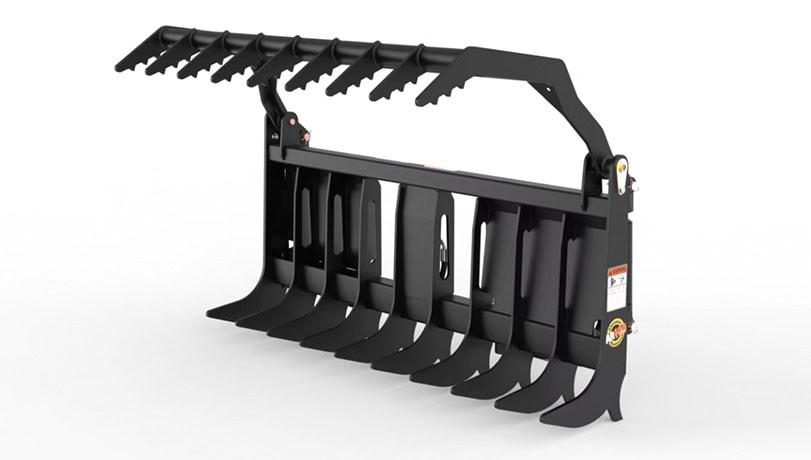
Overview & Specs
The Land Pride SGC1060 is a claw grapple for suitable tractor-loader work involving awkward loose material. It deserves consideration when a bucket struggles to retain permitted brush or similar material through pickup, travel and placement. Its defining buying question is the complete tractor-and-grapple match, including the mounting version, hydraulic control and actual load geometry.
One restriction should be settled immediately: the May 15, 2024 operator manual says not to attach SGC10 grapples to skid steers. A skid-steer-style universal mounting plate describes the interface, not approval for a skid steer as the host machine. For Canadian buyers comparing used attachments by their mounting plates, this distinction is essential.
On This Page
ToggleIdentify the mount and the machine
The SGC1060/SGC1072 manual lists universal quick-attach, Kubota B Series and no-mount configurations. The tractor requirements give a 30–55-hp range and an appropriate hydraulic connection. The actual loader and attachment combination still needs its own fit and capacity assessment.
For a used offer, ask which mount is fitted now. Do not assume that a reference to a Kubota tractor establishes the correct interface for every B Series machine or that a previous owner’s adapter is approved for your loader. Identify the hardware, locking engagement and any modification.
A no-mount version is not permission to improvise a structural connection. Any completed installation must meet the applicable requirements. Include the weight and geometry of adapters or mounting work when comparing the final package.
The useful specifications
| Item | SGC1060 value in the cited manual |
|---|---|
| Weight, universal mount | 389 lb |
| Weight, Kubota B Series mount | 378 lb |
| Overall width | 62 inches |
| Jaw opening | 39½ inches |
| Teeth | 10 lower; 9 upper |
| Maximum hydraulic pressure | 3,500 psi |
The same manual contains a rated operating load expressly restricted to approved Australian combinations. This guide does not use that figure as a Canadian payload rating. Use the relevant host-machine information and approved configuration instead of transferring a regional table into a general sales claim.
Retention is different from payload
The upper jaw can help retain a suitable irregular load, but closing around it does not establish that the loader may carry it. Material mass, its position and the height or reach needed for placement remain separate questions. An object that fits between the jaws can still be unsuitable for the machine.
Brush makes this particularly easy to misjudge. Two similarly sized bundles can differ in mass and balance. A long branch can project far beyond the frame, changing route clearance even when its weight appears modest. Assess the whole bundle rather than treating the attachment width as the load envelope.
Use known, permitted material for a demonstration. The goal is to evaluate support, retention, visibility and controlled placement, not to discover the loader limit by increasing the load. A momentary lift does not approve a complete handling cycle.
For illustration only, a 300-lb material bundle plus the listed 389-lb universal-mount attachment totals 689 lb before other equipment. That mass inventory is useful, but it is not a capacity calculation. The reference point, geometry and operating position still have to match the loader’s documented limits.
Why a larger jaw is not automatically more productive
Opening size can help accommodate awkward shapes, but the volume captured is not the completed job. A bulky pickup may take longer to position, obstruct the view or require more careful placement than a smaller controlled bundle. The practical measure is a safe, repeatable full cycle.
Start by describing the recurring material: branch bundles, mixed loose debris or another permitted application. Note what must be retained and what should remain behind. An open-tine grapple and a solid bucket do not manage small loose particles in the same way.
If much of the job consists of material that escapes through the openings, the grapple may leave substantial cleanup. Include that follow-up operation in the comparison. A bucket may be the better tool for some portions even when the grapple is useful for the awkward larger material.
The grapple, bucket and pallet-fork comparison frames the choice by support, containment and retention. It helps avoid buying a grapple simply because it looks capable of holding everything.
Hydraulic pressure is a limit, not a setup target
The 3,500-psi maximum is not a recommendation to increase the tractor’s pressure. The tractor, attachment, hoses, couplers and controls must operate within the applicable requirements. Do not change relief settings to make a questionable load feel more secure.
Evaluate how the operator will command the jaw while using the loader. Third-function and other control arrangements can produce different routines, and installation completeness matters. Correct couplers alone do not establish that the control package is suitable or that hoses clear moving components.
Have the full range of permitted movement checked using the manufacturer’s procedure. Hose routing that looks tidy with the loader parked may behave differently as the attachment rolls or lifts. Any adapter or changed mounting geometry belongs in that check.
Include the complete hydraulic installation in the quotation. A grapple price without the required tractor-side equipment is not directly comparable with a ready-to-use package. The loader capacity guide also explains why attachment capability and host-machine lift figures must remain separate.
Plan the destination before pickup
A handling job has several stages: approach, pickup, travel, placement and return. The most difficult stage may be releasing material at the destination rather than lifting it initially. Identify where the material will go and whether the loader can reach the required position within its approved limits.
For brush cleanup, leave appropriate access around the receiving area. A pile that grows across the route can lengthen every later cycle. A convenient initial location may become awkward as the project progresses. Plan the full job rather than only the first load.
Evaluate the return route too. Obstacles, gates and turning space can make a wide or projecting load impractical even when the empty tractor fits comfortably. Snow, soft ground or ice can change route suitability; they do not increase capacity or justify a marginal load.
Keep people clear and follow the manual’s load-control procedures. This buying guide does not substitute for training on the specific tractor. The purchase decision should include whether the regular operator can manage the required routine confidently and correctly.
Width should follow the actual cleanup task
The SGC1060’s 62-inch envelope should be checked against gates, storage and the intended work area. The wider SGC1072 is a separate option, but greater width is not an automatic upgrade on a smaller tractor or a constrained site.
Think about both what the grapple must span and where the material’s centre of gravity will lie. A wide collection of light brush and a compact heavy object create different handling questions. Neither can be approved from nominal width alone.
Compare the complete mounted mass and the actual loader configuration before choosing a larger frame. More attachment steel can consume capability without improving the permissible material load. The appropriate size is the one that suits the verified host and recurring work.
Compare with a lighter claw grapple
The SGC0660 guide describes another Land Pride claw-grapple option. Do not assume that similar model widths establish identical tractor requirements, opening geometry, pressure limits or weight. Check each actual configuration.
A heavier grapple may be appropriate for a compatible tractor and specified task, but “heavier duty” is not a substitute for matching. If the lighter approved attachment already completes the work and the loader is the limiting component, adding weight may offer little benefit.
Conversely, selecting the lightest available tool without checking its permitted duty is also poor economy. The complete system must satisfy every relevant limit. The right comparison is between suitable packages, not between the largest numbers on two advertisements.
Used inspection should include the tractor-side interface
Start with identification and completeness. Inspect the frame, teeth, mounting surfaces, pins, bushings, cylinders, hoses and couplers using the prescribed shutdown and support procedure. Look for distortion, missing parts and undocumented modifications.
Have questionable repairs assessed rather than assuming that extra weld material makes the attachment stronger. Condition needs interpretation in context. These are general inspection priorities, not evidence that SGC1060 grapples commonly fail in a particular location.
Inspect the loader carrier and locks as well. A sound grapple does not correct a worn or damaged host connection. A used demonstration on the seller’s tractor cannot establish fit on a different loader with another mounting arrangement.
Check jaw movement and the permitted range of attachment movement before a controlled load demonstration. Price all identified repairs and installation work. A package missing tractor-side hydraulics or mounting components should not be compared with a complete offer as though the difference is only cosmetic.
Count complete cycles, not impressive pickups
Suppose a hypothetical cleanup requires eighteen cycles. At five minutes per complete cycle, that is ninety minutes. If a better staging arrangement reduces each cycle by one minute, the total falls by eighteen minutes without changing the grapple.
By contrast, saving twenty seconds at pickup across those eighteen cycles saves only six minutes. These invented numbers are not SGC1060 productivity claims. They illustrate why destination and travel planning can matter more than an eye-catching pickup demonstration.
Include final cleanup, attachment changes and material disposal. If small loose debris still needs a bucket, count that work. If another method can process material in place and avoid carrying it, compare that process on the required finished result rather than assuming every cleanup must involve hauling.
Ownership costs and seasonal readiness
Use a complete delivered quotation with the required hydraulic and mounting equipment. Then add realistic allowances for maintenance, storage and tractor operation. Do not rely on unsupported claims of resale value, service life or fuel savings.
For an illustrative calculation, CAD 500 of annual attachment and setup cost spread across twenty suitable jobs is CAD 25 per job. At four jobs, it is CAD 125 before tractor costs and labour. These are hypothetical inputs, not Canadian SGC1060 prices.
For occasional work, compare rental or a service on the same scope. For recurring cleanup, convenience and availability can justify ownership even without a clear direct saving. State those benefits explicitly and keep the workload realistic.
Frequently asked questions
Can it be fitted to a skid steer because the plate matches?
No. The cited SGC10 manual expressly prohibits skid-steer use. Interface compatibility is not host-machine approval.
Is 3,500 psi the pressure I should set on the tractor?
No. It is the attachment’s stated maximum. Use the approved system configuration and do not increase pressure to compensate for an unsuitable task.
Does the Australian load table apply in Canada?
The manual restricts that table to approved Australian combinations. It is not used here as a general Canadian payload rating.
Does the jaw opening define the maximum load?
No. Fit, support, retention, mass and loader geometry all matter. An object fitting inside the grapple is not proof of a permissible lift.
Who should shortlist the SGC1060?
An owner with a compatible tractor-loader combination and repeated material-handling work that benefits from a claw’s retention. The complete route, destination and installed equipment should be verified before purchase.
Share your experience
Help other Canadian buyers — leave a quick review for the
Land Pride SGC1060
There are no reviews yet. Be the first one to write one.
