
Overview & Specs
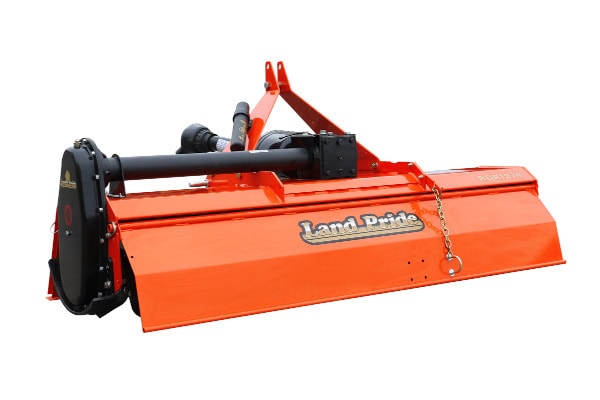
The Land Pride RGR1258 is a 58-inch reverse-rotation, gear-drive rotary tiller. It is a candidate for preparing suitable garden or landscaping soil when the owner wants that rotor action and has a tractor that meets the complete implement requirements. It should not be chosen simply because reverse rotation sounds more aggressive or gear drive sounds indestructible.
Start with the soil. Land Pride cautions against reverse tilling in rocky conditions. If rocks are a recurring feature of the intended area, that limitation belongs near the beginning of the purchase decision, before width, price or a preferred brand. An unsuitable application does not become suitable because the tractor has additional power.
On This Page
ToggleDocumented RGR1258 specifications
The manufacturer’s specification sheet dated December 16, 2021 lists the RGR1258 at 530 lb, with a 58-inch working width and 63½-inch overall width. Its recommended tractor range is 23–60 PTO hp. The documented rotor has seven flanges with six tines each, a 17-inch swing diameter and reverse rotation. The drive operates from a 540-rpm PTO through an oil-bath spur-gear arrangement.
These figures describe that dated specification, not every altered used example. The current family page distinguishes the forward-rotation RGA from the reverse-rotation RGR. Keep that letter distinction when requesting parts or comparing advertisements.
The sheet’s metric conversion beside its seven-inch depth entry contains an obvious inconsistency. Do not copy the printed millimetre value as though it agrees with seven inches. More importantly, the listed depth capability is not a requirement to till every plot to that depth.
What reverse rotation changes in the decision
Rotor direction describes the working action of the tines relative to forward travel. It does not instruct the operator to drive the tractor backward while the tiller remains in the ground. That distinction matters when a used seller casually describes the machine as a “reverse tiller.”
Land Pride associates reverse action with more aggressive penetration and residue incorporation in suitable conditions. Treat those as application characteristics to assess, not a promise of a superior result in every soil. A finer-looking surface is not automatically the correct preparation for the intended planting operation.
Describe the desired outcome: working depth, acceptable clod size, residue condition and the next operation. A demonstration can then compare useful results rather than rewarding whichever machine throws the most soil.
If the plot is already regularly prepared and only needs a modest operation, maximum aggressiveness may not be the most valuable feature. If the starting condition is difficult, first establish that it is within the machine’s intended application rather than assuming reverse rotation resolves every problem.
Rocky soil is a selection boundary
The manufacturer’s warning about rocky conditions is specific enough to affect the shortlist. Do not soften it into a promise that a slip clutch will make rock encounters acceptable. Protection equipment does not expand the permitted application.
Inspect the area and establish what preparation is required before tilling. Surface appearance may not reveal buried debris or stones. A tiller is not a substitute for evaluating an unfamiliar site.
If the ground cannot be made suitable for the proposed operation, investigate another preparation method or qualified service. It may be more economical to resolve the site problem than to buy a heavier tiller and repeat the same unsuitable task.
Conversely, do not generalize from one stony corner to every part of the property. Map the intended working area accurately. A well-defined suitable garden may present a different decision from reclaiming an entire rough field.
Gear drive describes construction, not a lifetime guarantee
The RGR1258’s documented gear-drive arrangement differs from chain-driven tiller families. That identifies the system to inspect and maintain; it does not prove a fixed service life, lower ownership cost or immunity from damage.
Compare lubrication access, condition, documentation and parts support for the actual unit. A neglected gear-drive machine can be a less attractive purchase than a well-maintained alternative with another drive type. The maintenance history matters more than a generic claim that one mechanism never needs attention.
When inspecting used equipment, look for leakage, damaged covers, missing plugs and evidence of unauthorized repairs. Have abnormal noise or play assessed before use. These are general inspection considerations rather than statements of a known RGR1258 failure pattern.
Keep rotor direction and drive type as separate comparison columns. Choosing reverse rotation does not require choosing a particular drive architecture across every manufacturer’s range, and selecting gears does not by itself determine the soil action.
Forty-two tines are a complete working set
Seven flanges multiplied by six tines gives 42 tines in the cited arrangement. Count and identify them during a used inspection. Missing or mismatched components can make a machine look more complete from above than it actually is.
Assess wear across the rotor rather than inspecting only the easiest tine to reach. Confirm the correct replacement parts and fasteners. An apparently inexpensive tiller can require substantial restoration if many working components need replacement.
Do not judge the need for replacement solely by whether the rotor still turns. The relevant question is whether the complete assembly is in the correct safe condition to produce the intended result. Inspection must follow the shutdown and support requirements in the manual.
Obtain a written repair estimate for identified problems. Avoid assigning a universal cost per tine or service-life expectation without a current parts quotation and evidence for the specific machine.
Power and carrying requirements are independent
The cited range is PTO horsepower, not the engine number most prominently displayed in a tractor advertisement. Check the exact tractor’s shaft rating for its transmission and configuration. Aglist’s PTO versus engine horsepower guide explains that comparison.
The tractor must also carry the tiller appropriately. Its 530-lb listed mass acts behind the linkage, and any fitted hitch equipment forms part of the geometry. A tractor that passes the power screen can still be an unsuitable carrying or clearance match.
Check the driveline through the permitted movement using the applicable setup instructions and competent assistance. Do not assume that a shaft from a previous tractor remains correct after changing the hitch or host machine.
The quick-hitch guide addresses these geometry questions. Treat the exact driveline option as part of the package rather than assuming every listed option works with every hitch arrangement.
Fit the bed layout before buying the width
The 58-inch working strip and 63½-inch outside width answer different questions. The first concerns prepared soil; the second concerns access and clearance. Neither describes all the space needed for the tractor to turn and line up.
Draw the beds, permanent paths, fences and headlands. Identify where the tractor tyres travel and whether the intended sequence leaves the required area prepared. Do not assume an offset feature from another tiller family exists on this model.
For comparison, the RTA1258 guide discusses a different forward-rotation model and its documented offset conditions. Similar working width does not make the two complete packages identical.
A wider implement can be efficient on a broad rectangle but awkward in separated narrow beds. If access and turning dominate, the right change may be a different preparation method rather than another increment of tractor horsepower.
Adjust for the required result, not maximum pulverization
The RGR/RGA operator manual describes depth adjustment through the skid shoes and texture adjustment through the rear deflector and suitable travel. It also prohibits turning or backing with the tines in the ground. Follow the complete procedure for the actual equipment.
Inspect the result after a short representative section. Check depth and texture below the surface rather than judging only the top appearance. If the desired condition is already achieved, another pass needs a reason.
Separate a machine limitation from unsuitable timing. Soil condition can make the intended operation inappropriate even when the implement is correctly matched. For Canadian garden work, scheduling flexibility can be more useful than expecting a machine to compensate for every spring condition.
Keep the next operation in view. The objective is a planting area prepared to its requirements, not a demonstration of how finely the machine can process the same strip repeatedly.
Compare time using completed preparation
Suppose a hypothetical plot is 800 square metres. At an effective width of 1.35 metres and an appropriate assumed travel speed of 2 km/h, straight-line coverage is 2,700 square metres per hour. With an assumed 60% allowance for field efficiency, the working rate is 1,620 square metres per hour.
One pass would take about 30 minutes; two comparable passes would take about an hour before separate preparation and cleanup. These are invented planning inputs, not measured RGR1258 performance or recommended settings.
If one suitable arrangement achieves the required result in one pass and another requires two, that difference may outweigh a modest width advantage. But it must be demonstrated under comparable conditions, not assumed from rotor direction alone.
Include attachment changes, inspection, access and cleanup in the session. On a small garden, these fixed tasks may take longer than the working pass. A large machine can therefore produce a much smaller whole-session saving than its theoretical coverage suggests.
Seasonal ownership and used condition
Inspect the machine before the intended working window, especially if it has been stored for months. Confirm the driveline, protection assembly, lubrication and working parts are ready according to the manual. Finding missing components when the soil is ready can disrupt the project more than the eventual repair cost.
Provide a stable storage and connection area. The parked tiller should use the prescribed support arrangement, and the tractor should be able to approach it practically. A difficult connection routine can discourage timely use even when the tool itself is appropriate.
For a used purchase, inspect the frame, hitch, rotor, tines, skid shoes, deflectors, stand and drive components. Identify modifications and obtain the serial-specific parts information. A fresh paint finish is not evidence that the working system has been restored.
Compare the complete ready-to-use cost with rental or contracted preparation if use is infrequent. Include required driveline work and repairs, not merely the seller’s asking price. There is no basis here for a guaranteed resale value or fuel-saving claim.
Frequently asked questions
Does reverse rotation mean driving backward?
No. It describes rotor action. The manual prohibits backing with the tines in the ground.
Is it appropriate for rocky soil?
Land Pride cautions against reverse tilling in rocky conditions. Resolve the application before considering a purchase.
Does gear drive eliminate maintenance?
No. Inspect and service the actual drive system as specified. Construction type is not a maintenance exemption.
Can I assume the RTA1258’s offset arrangement applies?
No. They are different models and families. Use the RGR1258’s own documentation and actual hardware.
What makes it worth shortlisting?
Suitable soil, a verified tractor match, a workable bed layout and a demonstrated preparation result that benefits from this configuration. The model is less convincing when the decision rests only on a preference for gears or aggressive tilling.
Share your experience
Help other Canadian buyers — leave a quick review for the
Land Pride RGR1258
There are no reviews yet. Be the first one to write one.
