
Overview & Specs
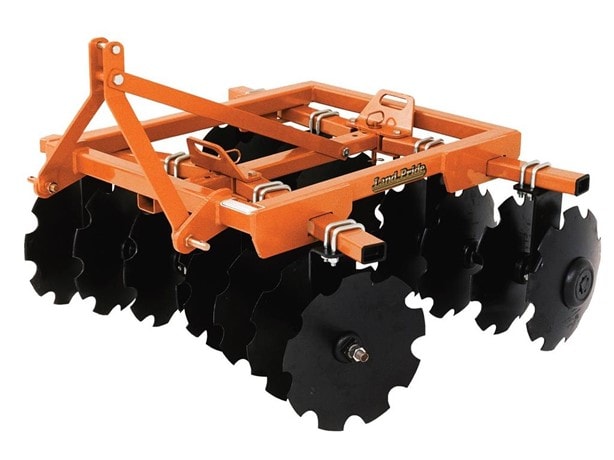
The Land Pride DH1572 is a six-foot three-point disc harrow for soil-working tasks suited to its gang-disc arrangement. It is worth assessing when the project needs cultivation through forward travel rather than powered rotary tillage. The important buying question is the soil condition and finished result required, not whether a six-foot implement appears proportionate to the tractor.
Its adjustable front and rear gangs give the owner choices about working action. Those adjustments are useful only when the operator understands the desired result and the tractor can handle the actual draft and carrying requirements. More aggressive settings are not automatically better preparation.
On This Page
ToggleCurrent manual versus older family tables
The April 16, 2025 manual lists the DH1572 with a 72-inch cultivation width, 714-lb weight, twenty 18-inch discs and Category 1 hitch. Its tractor-requirements section gives the DH15 series a 25–65-hp range. The current table lists 0, 7, 14 and 21-degree positions for both DH1572 gangs.
An older family sheet presents the rear-gang choices differently. This guide uses the newer manual consistently rather than combining the old rear-angle entry with current configuration details. Identify a used machine and its applicable documentation before assuming every adjustment described here applies unchanged.
The shared table also covers larger DH25 machines. Their disc sizes, masses and hitch arrangements should not be transferred to the DH1572. Reading across the correct model column is essential when comparing offers.
A disc harrow works through travel
The working action begins as the discs engage suitable soil and the tractor moves forward. This is a different mechanism from a PTO-driven tiller, where a powered rotor provides the cultivation action. Similar nominal widths do not establish equivalent results or tractor requirements.
For the DH1572, tractor suitability involves the ability to pull the implement under the intended conditions as well as carry it. A successful empty lift test cannot demonstrate the draft requirement in soil.
Describe the ground honestly. Previously cultivated soil, an area with substantial residue and a new plot with uncertain buried material create different questions. Do not treat them as equivalent simply because their surface areas match.
The rotary-tiller comparison explains a separate powered-cultivation choice. Use it to compare processes, not to assume that a disc harrow should leave the same texture in the same number of passes.
Front and rear gang settings deserve separate attention
The two gang positions should be recorded independently. Their relationship affects the working result, and a maximum available angle is not a universal recommended setting. Use the applicable adjustment procedure and evaluate the result in suitable conditions.
The manual explains that more aggressive gang angles increase cutting action and power demand. This means a setting change can alter the tractor’s workload even though implement width and mass remain unchanged.
During a demonstration, record the actual configuration rather than simply noting that the machine was a DH1572. A comparison with another harrow is incomplete if one has a mild setup and the other is working more aggressively.
Change one relevant factor at a time under the prescribed secured procedure. That makes it easier to understand why the surface changed. Randomly altering several settings can produce an acceptable-looking patch without explaining how to repeat it.
Decide what the next operation needs
A seedbed, a preliminary cultivation pass and a surface prepared for another finishing tool can have different acceptance criteria. Define the required result before judging the harrow’s performance.
Inspect the worked layer and the surface after a representative pass. Consider remaining residue, larger clods, ridges and any follow-up operation. An area is not necessarily ready simply because the soil has visibly moved.
If the next step requires a different texture or profile, compare the complete sequence. A second implement may be appropriate, but it should respond to a specific requirement rather than an assumption that more passes always improve the result.
The SP2060 soil-pulverizer guide covers a distinct finishing mechanism. It can help frame a process comparison without suggesting that either tool replaces every stage of site preparation.
Centre treatment and optional equipment
The current DH1572 table lists optional adjustable scrapers and a nine-inch centre sweep intended to address a centre ridge. Confirm whether those components are supplied and whether they solve a problem demonstrated in the actual work.
A centre accessory should not be purchased merely because another owner uses one. Assess the surface left by the correctly set machine, identify the remaining issue and verify the applicable option.
Scrapers likewise need to be considered within the manufacturer’s operating limits. They are not a reason to work soil that is too wet for the operation. The manual says to discontinue when soil builds up or sticks to the discs until conditions are suitable.
List the equipment on the quotation. A photograph showing accessories is not evidence that they are included in the base price. Missing brackets or incorrect parts can turn a seemingly inexpensive addition into an incomplete installation.
Discs are a set, not isolated wear items
Twenty discs create a working system whose condition should be assessed across the machine. A used purchase with inconsistent diameters, damage or mismatched components needs more scrutiny than a quick look at the outermost blade.
The manufacturer offers smooth or notched disc arrangements in the family documentation. Identify the actual installed configuration and evaluate it for the intended soil-working job. Do not infer that a visual difference is a harmless substitute for the correct specified component.
Measure and inspect through the proper secured procedure with competent help where appropriate. Price the identified replacements, bearings, spacers and related hardware as a complete return-to-service package.
These are general used-equipment priorities, not a claim that the DH1572 has a particular failure pattern. Service history, condition and correct assembly matter more than an unsupported reputation attached to a model name.
The tractor range is only the first screen
Respect both ends of the documented 25–65-hp range. A Category 1 connection does not approve an oversized tractor, and additional horsepower does not erase the attachment’s design limits.
Within the range, check rear carrying geometry, ballast requirements and clearance. The 714-lb figure is an input to that assessment, not a full description of the load on every tractor’s linkage.
Include any quick hitch from the beginning. The quick-hitch compatibility guide explains why pin category and complete geometry are separate questions. Confirm the actual implement, hitch and tractor combination.
Then assess the working load in representative suitable soil. A tractor that carries the harrow comfortably may still require a less aggressive setup or a different plan for the intended area. A demonstration should answer both carrying and working questions.
Allow room for the proper pass pattern
The manual prohibits discing in reverse and instructs lifting before turns. Build that operating requirement into the plot layout. A time estimate that assumes tight continuous turns with the machine engaged is not describing the prescribed routine.
Measure the whole implement and tractor envelope for gates, storage and headlands. Cultivation width is not a complete transport dimension. The route into the plot can be as important as the plot itself.
For a long open strip, pass planning may be straightforward. For several small irregular areas, repeated alignment and repositioning can dominate. Compare the actual layout rather than using a single theoretical hectares-per-hour figure.
If the property lacks suitable turning space, a narrower or different method may be more practical despite lower nominal coverage. The widest compatible implement is not always the most useful one.
A realistic area calculation
Use effective working width after the planned overlap and a suitable observed travel pace. As invented inputs, take 1.65 metres and 4 km/h. Straight-line coverage is 6,600 square metres per hour; with an assumed 65% field efficiency, it becomes 4,290 square metres per hour.
A hypothetical 6,000-square-metre area takes about 1.4 hours for one comparable pass. If the actual required result takes two passes, the working portion becomes about 2.8 hours before setup and cleanup. These figures are not tested DH1572 productivity or operating-speed recommendations.
The example shows why pass count deserves as much attention as width. If a different process reaches the required result with fewer stages, compare total completion time rather than the fastest individual pass.
Record what remains to be done after discing. Seed application, finishing or other work should not disappear from the comparison simply because the soil looks different. The end point is the project’s required condition.
Canadian timing and site preparation
Plan around workable ground, not just equipment availability. A short spring window can create pressure to begin, but the manual’s wet-soil limitation still applies. Owning the harrow does not make an unsuitable day appropriate.
Inspect for debris and other site constraints before engagement. Ground previously used for another purpose may contain material not apparent from the surface. Complete the appropriate site assessment rather than using the implement to discover obstacles.
Separate one-time preparation from recurring cultivation. A new garden or acreage project may need work that will not recur annually. That distinction can favour contracting initial preparation and owning a different tool for later maintenance.
Do not prescribe a universal Canadian cultivation schedule. Location, soil, intended crop and management plan determine the relevant timing. The machine should serve that plan rather than become the reason for unnecessary disturbance.
Evaluate ownership through actual use
Compare purchase, required setup, repairs, storage and tractor costs with suitable alternatives on the same finished result. A harrow price should not be compared with a contractor’s complete establishment package as though both supply identical work.
For an invented example, CAD 2,400 of net ownership cost allocated over eight years plus CAD 100 annual maintenance produces CAD 400 per year before tractor costs and labour. At four projects annually, that is CAD 100 per project; at one, CAD 400.
These are hypothetical inputs, not market prices or expected repair costs. Replace them with actual quotations and a realistic workload. Availability and scheduling control can still justify ownership, but they should be stated directly.
For used equipment, include the time needed to obtain parts and restore serviceability. A bargain that misses the appropriate working window can be less useful than a more expensive ready machine or a suitable service.
Frequently asked questions
Does the DH1572 need PTO power to turn its discs?
Its cultivation comes from forward travel through the soil, unlike a powered rotary tiller. The tractor still needs to meet the complete carrying and working requirements.
Are maximum gang angles always best?
No. They change the action and demand. Choose a permitted setup around the required result and actual conditions.
Can scrapers make wet soil suitable?
No. The manual calls for discontinuing when soil buildup indicates unsuitable wet conditions.
Can I turn sharply with the discs engaged?
The manual instructs lifting before turns. Plan headland space for the proper routine.
What should a demonstration establish?
A repeatable acceptable result on representative suitable soil, with a correctly matched tractor, practical turns and an understood number of passes.
Share your experience
Help other Canadian buyers — leave a quick review for the
Land Pride DH1572
There are no reviews yet. Be the first one to write one.