
Overview & Specs
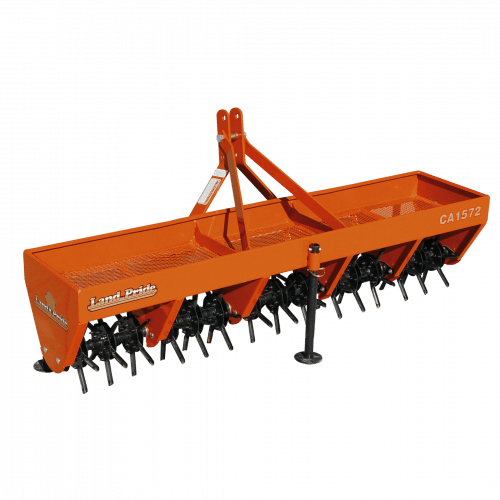
The Land Pride CA1572 is a three-point core aerator for owners assessing a recurring turf-aeration job with a compatible tractor. It uses a set of spoons to remove cores rather than cultivating the whole surface like a rotary tiller. Its purchase should follow a decision that this treatment is appropriate for the turf, not merely a wish to add another lawn implement.
The model number also deserves careful interpretation. The detailed specification gives a 66-inch working width, while the overall machine is slightly over 72 inches wide. For coverage, access and ownership calculations, those are different dimensions with different uses.
On This Page
ToggleThe CA1572 specification, with its qualifications
Land Pride’s July 27, 2022 detailed sheet lists 208 lb of implement weight, a maximum 500 lb of added tray weight, 90 spoons in 15 gangs, a 66-inch working width and 72 5/16-inch overall width. It describes a nominal three-inch penetration dependent on ground conditions and added weight.
The sheet identifies Category 0, Category 1 and Category 1 limited hitch arrangements, with named Land Pride quick-hitch compatibility. This is not permission to attach the aerator to every machine with a broadly similar hitch. Verify the actual tractor and complete arrangement.
Promotional literature gives a different penetration range. This guide does not combine that claim with the older detailed table to promise a deeper result. Match the documentation to the machine offered and assess actual core removal in appropriate conditions.
Core removal is not the same as general lawn repair
An aerator addresses a particular operation. It does not automatically correct every reason a lawn looks poor. Before buying, establish whether the proposed treatment fits the problem and how it connects to the wider maintenance plan.
A patch with an underlying drainage or grading issue may require a different assessment. A worn traffic route may need a change in use as well as a turf operation. Do not judge the implement by an expectation that one traversal will resolve every visible symptom.
Separate the machinery question from the turf-management question. The machine needs to remove cores consistently within its documented application. The owner also needs an appropriate treatment plan, timing and follow-up for the particular lawn.
That distinction avoids two mistakes: purchasing equipment before identifying the need, and blaming the tool when it performs its operation correctly but the original problem requires more than that operation.
Added weight has both a limit and a carrying consequence
The tray limit is not a recommendation to fill it to the maximum for every job. Added mass must follow the prescribed arrangement, remain within the implement limit and be compatible with the tractor’s carrying requirements.
The base figure and full permitted tray addition total 708 lb before any other equipment: 208 plus 500. This arithmetic describes a possible mass inventory, not approval for a particular tractor or an instruction to use maximum weight.
The September 10, 2024 manual additionally states a tractor rated three-point lifting capacity requirement of at least 750 lb. Meeting that number does not remove the need to check the actual hitch geometry, equipped load and tractor instructions.
Include quick-hitch equipment and other relevant additions when evaluating the combination. A successful empty lift demonstration is not enough to establish the working configuration. If the proposed setup is uncertain, resolve it before bringing ballast to the field.
Penetration is an observed result
The detailed sheet expressly makes penetration conditional. Ground condition and permitted setup affect the result, so a nominal figure should not be advertised as a uniform core length across an entire property.
Choose a representative inspected area for a trial. Examine whether cores are being removed and whether the result is consistent enough for the intended treatment. Count completed work only when the required operation is actually occurring.
If results differ between sections, investigate the site and setup instead of assuming that another pass or more weight is automatically correct. A machine can be working properly while encountering conditions that change its effectiveness.
Document the starting conditions and actual result. A photograph of the aerator attached to a tractor provides much less buying evidence than a record of core removal on a representative suitable surface.
Map treatment areas separately from property size
Begin with the maintained turf that is intended to receive treatment. Exclude buildings, beds, hard surfaces and other areas outside the operation. The property acreage is not the same as the area the aerator will cover.
Mark known obstacles and services through the appropriate local process. Sprinkler components, buried lines and other features need to be accounted for before ground engagement. The manual includes site-obstacle precautions; shallow working depth should not be treated as proof that nothing can be contacted.
Divide the lawn into practical sections and identify turning areas. Narrow corridors, trees and curved borders can make the effective working routine different from a large open rectangle.
A tractor-mounted machine may fit a broad area well while being inconvenient in smaller sections. Those sections can be handled by a different suitable method. The purchase does not need to force one machine into every part of the property.
Why 66 inches matters in the time estimate
Using overall width as treated width overstates theoretical coverage. The CA1572’s documented working width is 66 inches, approximately 1.68 metres, while its access envelope is larger. Use each dimension for its own question.
As an invented planning example, suppose appropriate overlap gives an effective width of 1.5 metres and a suitable pace of 4 km/h. Straight-line coverage is 6,000 square metres per hour. With an assumed 60% efficiency, net coverage is 3,600 square metres per hour.
A 3,000-square-metre treatment area then takes about 50 minutes for one planned pass, before separate preparation, connection, cleanup and any additional prescribed treatment. Those values are not tested CA1572 productivity or operating-speed advice.
If turns and obstacles reduce efficiency to 40% at the same assumed width and pace, the estimate becomes 75 minutes. That 25-minute difference illustrates why the property’s layout can matter more than a small nominal-width difference between implements.
Do not turn a coverage plan into an operating shortcut
The route must respect the implement’s instructions for movement and turning. The manual warns that excessively sharp turns with engaged spoons can damage them. A planning calculation that assumes instantaneous turns is therefore not a sound description of the job.
Provide room for the prescribed manoeuvres and assess the full tractor-and-implement combination. The front of the tractor clearing a tree does not guarantee clearance for the implement behind it.
Include travel between separated sections in the session estimate. A property with several small lawns can require more repositioning than an equal area in one rectangle. Buying only on hectares per hour can obscure that difference.
Observe the regular operator during a suitable demonstration. Access, visibility and the ability to follow the correct routine are practical purchase criteria alongside the specification table.
Ninety spoons make condition a whole-machine question
The number of working components means a used inspection should assess the full set rather than the first visible spoon. Missing, damaged or inconsistent parts can change the quality of the operation and the repair bill.
Check the gangs, bearings, frame, hitch, support stands and retaining hardware with the machine correctly secured. Examine any modifications and confirm appropriate parts. These are general inspection priorities, not claims that this model has a known recurring defect.
Price the identified work before comparing offers. Replacing one item and restoring a substantially worn set are different ownership propositions. A low asking price is less informative than the cost of a serviceable machine ready for the actual tractor.
The manual discusses plugged spoons and cleaning after operation. Include that work in the routine. A machine that is put away with obstructed working components may not be ready when the next treatment window arrives.
Storage and ballast handling belong in the decision
Choose an accessible stable parking location suitable for the prescribed storage procedure. Support stands are functional equipment, not an optional detail to ignore in a used sale. Confirm their presence and condition.
Plan how the approved added weight will be handled and stored. The ability to carry the implement does not establish a convenient or appropriate way to move individual ballast pieces. Include that task in the demonstration or setup discussion.
For a shared tractor, consider the sequence of seasonal attachments. An aerator used only occasionally should not obstruct a mower or other tool needed frequently. A simple storage plan can improve the value of ownership more than choosing the largest nominal model.
Keep the identification and setup records with the implement. If the tractor, hitch or ballast arrangement changes, revisit the affected checks instead of treating an earlier successful season as permanent approval.
Compare ownership with the actual treatment frequency
A recurring broad-area job can support ownership, especially when the tractor is already justified for other work. An occasional small treatment may favour rental or a service. Frequency and access to suitable alternatives should be explicit inputs.
For an invented comparison, assume CAD 1,800 of net attachment cost allocated across six years, plus CAD 60 per year for maintenance. That gives CAD 360 per year before tractor costs, storage, financing and labour. At two sessions per year it is CAD 180 per session; at one, CAD 360.
Those are not CA1572 market prices, service quotations or resale forecasts. Replace the assumptions with actual offers and compare the same treated area and scope. A service that includes diagnosis or follow-up should not be compared as though it supplies only tractor travel.
If the tractor would be purchased principally for this operation, include that larger ownership decision. If it already performs essential work, assess the incremental costs without pretending fuel, wear and operator time disappear.
Choose the maintenance process first
A core aerator, a seeder and a mower are different tools in a broader turf routine. The fact that one is useful does not establish that the others are necessary or that they should operate in a fixed sequence on every lawn.
The FDR1660 guide addresses regular finish mowing, while the quick-hitch guide helps assess connection requirements across implements. Use those supporting decisions without turning this aerator purchase into an assumption that every turf problem requires a complete new equipment collection.
For a Canadian property, the most useful initial record is a map of the intended treatment, a clear reason for it and a realistic annual frequency. That provides a stronger basis for equipment selection than the lawn’s appearance on one day.
Frequently asked questions
Does CA1572 mean a 72-inch working strip?
The detailed specification lists 66 inches of working width and 72 5/16 inches overall. Plan treatment and access using the appropriate figure.
Should I always add 500 lb?
No. That is the maximum tray allowance, not a universal operating recommendation. Follow the prescribed setup and complete tractor limits.
Is the listed penetration guaranteed?
No. It is expressly dependent on conditions and added weight. Assess actual core removal in a suitable trial.
Can one pass repair every poor lawn?
No. Aeration is a specific operation within a site-appropriate maintenance plan. Underlying problems may need a different response.
What should decide between ownership and a service?
The actual treatment area, frequency, tractor compatibility, storage and complete cost. Compare equivalent scope and practical availability rather than only an attachment price.
Share your experience
Help other Canadian buyers — leave a quick review for the
Land Pride CA1572
There are no reviews yet. Be the first one to write one.