Overview & Specs
The John Deere 4066M makes its strongest case when a buyer can name the powered implement that needs its extra output. It is an open-station compact tractor for owners who want to investigate more engine and PTO capability without making a premium cab the centre of the purchase. It should not be selected on the assumption that more horsepower automatically means a larger permissible pallet, a stronger rear hitch or more hydraulic flow.
For a Canadian small farm, that distinction can separate a useful upgrade from an expensive disappointment. A cutter or other PTO-driven tool may set the power requirement. Material handling may instead set a loader or tractor-platform requirement. Identify which problem the 4066M is being asked to solve before comparing it with a lower-powered compact or a utility tractor.
On This Page
Toggle4066M power and equipment reference
| Specification | John Deere Canada model table |
|---|---|
| Gross engine output | 48.5 kW / 65 hp / 65.9 PS |
| Engine family description | Four-cylinder turbocharged diesel, approximately 2.1 L |
| PTO output, PowrReverser | 40.4 kW / 54.2 hp |
| PTO output, eHydro | 38.7 kW / 51.9 hp |
| Implement hydraulic flow | 42.3 L/min |
| Rear hitch | Category 1; 1,135 kg at 24 inches behind link arms |
| Station | Open station |
These entries use the detailed Canadian 4066M page checked October 1, 2026. Broader family tables contain different PTO figures; this guide keeps the model-specific, transmission-labelled values together. Used tractors need documentation matching their serial number and equipment.
Find the bottleneck before buying more power
A productive comparison begins with a sentence such as “the intended tool requires this PTO output” or “the existing handling arrangement cannot place this load at the required height.” These describe different limits. The first may justify more engine capability. The second requires loader and stability information before engine size becomes relevant.
Write down the work you cannot presently complete, the frequency and the cost of the alternative method. If the problem occurs for only a few hours each year, a contractor or different delivery arrangement may deserve comparison with ownership. If it occupies much of the working season, a dedicated equipment upgrade may be easier to justify. Use actual local quotations rather than assumed payback.
Also distinguish slow work from unsuitable equipment. A correctly matched tool may be slow because of obstacles or frequent turning. More power does not remove those obstacles. Conversely, a tool outside the manufacturer’s requirements is not made suitable by accepting slow operation. The buying decision needs both compatibility and an honest picture of the work.
PTO work: use the correct version’s output
Consider a hypothetical implement with a stated minimum of 53 PTO hp. The two transmission-labelled entries in the table lead to different initial screening results. This is not an endorsement of a real attachment; it illustrates why the hood number and a generic online horsepower summary are insufficient.
After the power screen, check hitch category, tool mass, driveline arrangement and any ballast requirements. A tool can pass the power check and still be unsuitable because of its dimensions or the way it attaches. The size of a mower, tiller or other implement should be established from the complete documentation, not a universal horsepower-per-foot formula.
For mowing, record the condition of the vegetation and the desired finish. Maintained ground and neglected growth create different workloads. Then measure the narrowest passages and storage opening. Choosing the widest tool the power rating appears to allow can be counterproductive if it causes repeated awkward manoeuvres.
For hay-related equipment, inspect each proposed implement’s requirements individually. “Light hay work” is too broad to approve a baler or other specific machine. PTO demand, attachment arrangement, machine mass and field conditions all belong in that decision. A compact tractor’s engine rating should not stand in for a complete hay-equipment compatibility check.
Why hydraulic flow and hitch figures deserve their own columns
The published implement-flow and rear-hitch entries are not increased simply because this model has the larger engine. Compare those columns separately with the other candidates. This is a useful safeguard against treating every higher model number as a proportional upgrade in every capability.
A hydraulic motor attachment needs the correct supply and return arrangement, not merely a tractor with sufficient engine power. A grapple needs appropriate control of its clamp. A rear tool with several cylinders needs enough correctly configured functions. Record those requirements before deciding which valves and connections belong on the tractor.
Similarly, the rear hitch figure includes a measurement location. An implement extending well behind the tractor cannot be evaluated only by comparing its mass with a number measured at the links. Keep the specified measurement point attached to every rating in a comparison, then verify the proposed tool through the applicable instructions.
A useful equipment sheet has separate rows for power, lifting, hydraulics and physical fit. Passing one row does not pass the others. This is particularly valuable for a buyer moving from a smaller tractor and hoping to reuse an existing collection of implements.
Loader and pallet work may require a different upgrade
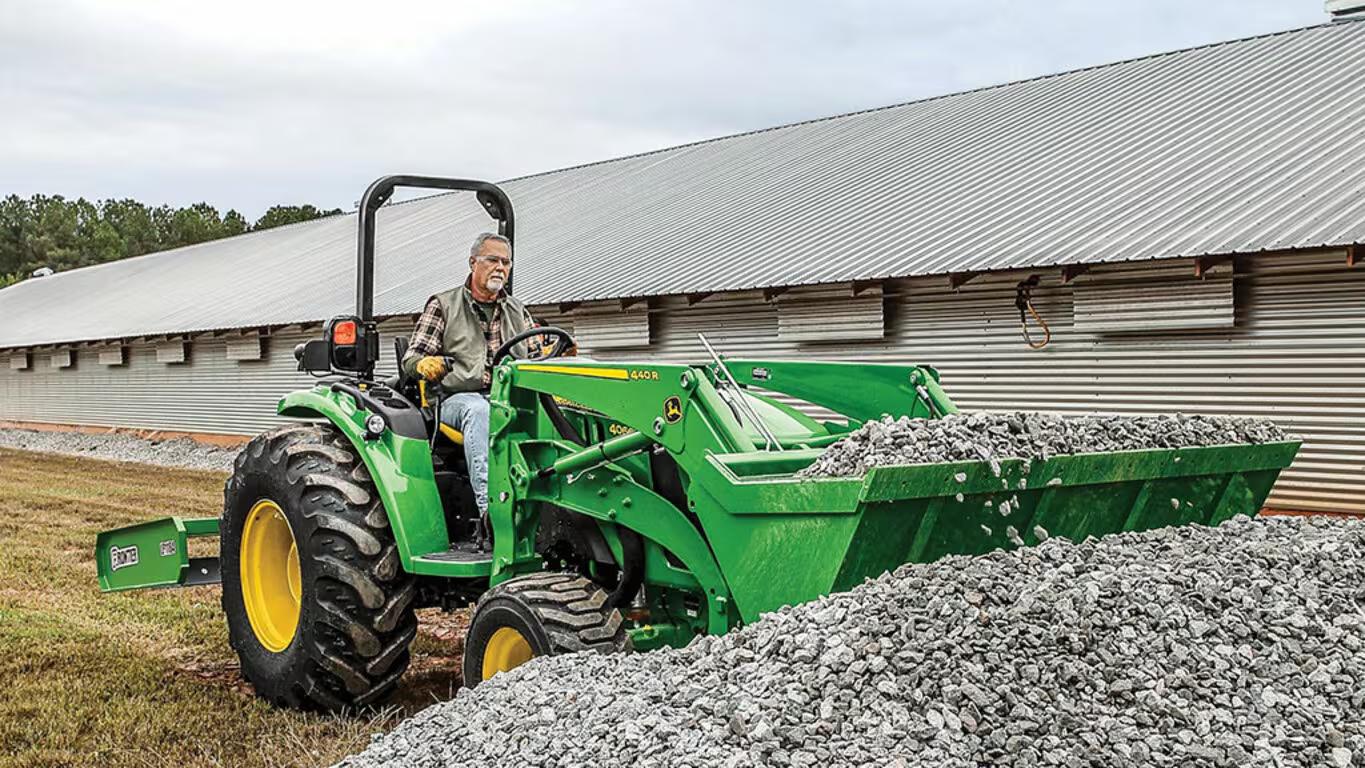
The 4066M appears in Deere’s 400E loader application information. Establish the actual loader version and attachment carrier on the quotation. If another loader is proposed, use its documented tractor pairing and equipment requirements rather than assuming interchangeability.
For a recurring pallet task, start with the delivery specification. Include product, packaging and pallet weight, the load’s dimensions and the height where it must be placed. An adapter and fork carriage also form part of the arrangement. A successful lift close to the ground is not proof that the load can be raised and positioned as required.
Where handling is the dominant job, compare the documented performance of the complete system with a suitable utility tractor or dedicated loader. The answer may be that the 4066M is a good powered-implement tractor but the wrong response to the heaviest handling task. That is a useful finding before purchase.
Bucket work needs an equally specific plan. Identify the material, pickup area and receiving container. A high-volume tool intended for light material is a different proposition from a bucket working dense aggregate. Match the attachment and loading method to the material rather than treating a full bucket as a standard unit of weight.
Open station: where the purchase saves complexity and where it compromises comfort
An owner doing mainly seasonal outdoor work may be comfortable choosing an open station. Evaluate the seat, access and view to the tools in normal work clothing. Repeatedly looking behind or reaching for an awkward control can matter more over a full day than it does in a five-minute showroom visit.
For winter chores on an exposed Prairie property, assess the actual duration and conditions. Include clearing around equipment, moving between work areas and dealing with subsequent drifting. If the operator cannot reasonably perform that routine in an open station, a cab-equipped alternative belongs in the comparison regardless of the engine value offered here.
Do not treat a future enclosure as a guaranteed substitute. Establish its compatibility, ventilation, visibility and effect on access before making it part of the plan. A planned modification with no confirmed equipment or price is an uncertainty, not a completed feature.
Choose a demonstration that resembles the working day
For a mixed loader-and-implement day, evaluate low-speed positioning, turning room and the controls needed to change jobs. Have the seller demonstrate the approved procedures, then assess whether they suit the regular operator. The Aglist transmission guide can help prepare questions for both versions.
For a longer field task, pay attention to sustained seating comfort and visibility to the implement. The demonstration should remain within approved operating conditions; it is not an opportunity to discover the machine’s limit by overloading it. Record observations that affect your work instead of relying on a general impression that the tractor feels powerful.
Include attachment changeover. If one machine is expected to handle several roles, the storage area and connection routine affect how willingly it will be used for short jobs. Missing connection hardware or an unsuitable parking surface can undermine the benefit of owning a versatile tractor.
Used 4066M: establish identity and condition
Confirm whether the advertisement is for the standard model or the separately marketed Heavy Duty version. Match the serial identity, transmission and hitch equipment to the documentation. Do not price one version from the features listed for the other.
Ask for service records tied to the tractor’s hours and serial number. Arrange a qualified inspection of drivetrain operation, hydraulic behaviour, loader mounts and pivots, hitch, axle, tyres and repair evidence. Review any warning or aftertreatment history using the appropriate diagnostic process. These checks describe due diligence, not a claim of recurring defects.
Examine the attachment collection with the same care. A tractor sold with a cutter, forks and a blade is not automatically a complete ready-to-work package. Confirm condition, guards, identification, compatibility and missing parts for each item. Assign value only after that inventory is clear.
Alternatives and ownership economics
The Kubota MX6000 and New Holland Workmaster 65 are useful starting points for a task-based shortlist spanning different equipment arrangements. Compare current manufacturer data for each exact version, especially PTO output, station, loader requirements and attachment fit.
If a smaller tractor already satisfies every essential tool, spending the difference on a better implement or storage arrangement may provide more practical value. If the work needs a different platform, buying the highest-powered compact may still miss the target. Aglist’s utility tractor buying guide helps frame that second comparison.
Request total equipment cost with tyres, loader, attachments, ballast and hydraulic options shown individually. Add transport, delivery and service arrangements. For hauling, establish the complete configured mass and dimensions; the weight of the bare tractor is not the transport load. No purchase comparison is complete until those supporting requirements are included.
A practical way to test the purchase case is to rank tasks by the constraint they impose. Mark each as power, attachment fit, handling, access or operator environment. If the essential tasks are mostly in the handling and access columns, the larger engine may not be the decisive upgrade. If a documented PTO requirement dominates, its role becomes much clearer.
4066M buying questions
Does the larger engine mean a higher rear-hitch rating?
Not by inference. Check the separate hitch specification and its measurement position. Engine output and rear lifting are different requirements.
Will it automatically handle larger bales?
No. Bale mass, attachment, loader configuration and the intended handling task require their own documented assessment.
Why are both transmission ratings shown?
Because an implement’s power requirement may make the version important. Combining the engine rating from one table with PTO output from another can mislead a buyer.
Is it a good replacement for a utility tractor?
Only when its complete capabilities fit the work. Similar horsepower does not establish equivalent chassis, loader, hitch or implement suitability.
When is the 4066M easiest to justify?
When a verified powered-implement requirement uses the additional output, the open station suits the operator, and the remaining tasks fit the documented equipment package.
Share your experience
Help other Canadian buyers — leave a quick review for the
John Deere 4066M
There are no reviews yet. Be the first one to write one.