Overview & Specs
Bobcat E38 Compact Excavator
On This Page
ToggleIntroduction
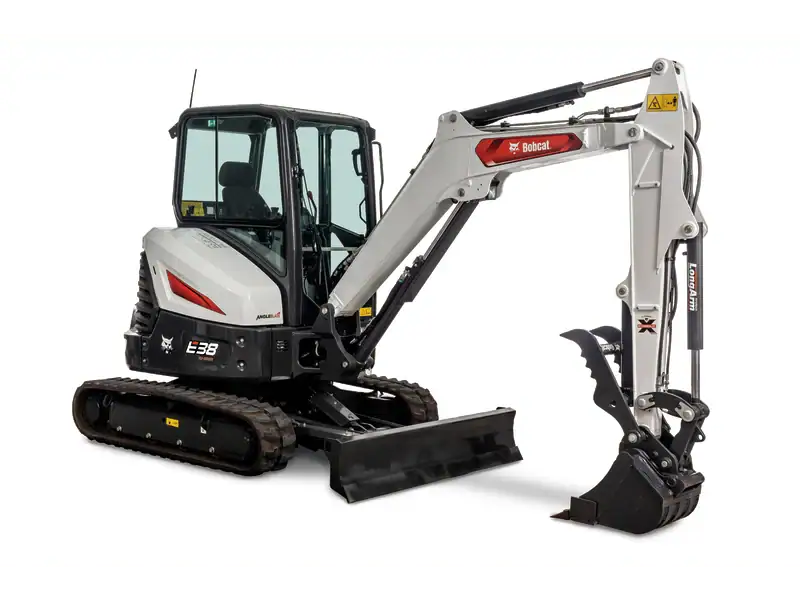
The Bobcat E38 is the higher-output sibling to the popular E35 — a 3.8-tonne compact excavator that brings 33 horsepower and upgraded performance to the same proven, zero-tail-swing platform. If the E35 is the class-leading all-rounder, the E38 is the choice for operators who want more usable power and lifting performance without giving up the tight-quarters capability that makes Bobcat’s compact excavators so popular. For demanding drainage, utility, and foundation work on prairie farms and acreages, the extra power earns its keep.
On Aglist, the value is in understanding where the E38 fits in the compact excavator market, with real owner and operator feedback beside the spec sheet. The numbers tell you what it digs and lifts; the reviews tell you how the added power feels in tough ground, how the controls feel over a long day, and how it holds up over seasons.
One naming note worth knowing, because it matters when shopping used: the E38 was previously sold as the 33-horsepower version of the E35. Bobcat renamed it the E38 in 2023 to align with its 3.8-tonne class. So if you see a “33 hp E35” on the used market, that’s the same machine now called the E38. We explain the E38’s zero tail swing — the most important design feature — below.
Configurations & Pricing Context
The E38 is part of Bobcat’s R2-Series compact excavator lineup, the 33-horsepower machine in the 3.8-tonne class. (It was formerly designated the 33-horsepower E35 before Bobcat’s 2023 renaming.) It’s offered in standard, long-arm, and extendable-arm configurations, with a canopy or optional enclosed cab. For Canadian year-round work, the enclosed cab with heat and A/C is the sensible choice.
The E38 runs the full range of compact excavator attachments — trenching and grading buckets, augers, hydraulic breakers, compactors, and more — with Bobcat’s coupler options including the X-Change system. For prairie drainage, utility, and site work that demands more power, it’s a strong machine.
Pricing varies by configuration, attachments, and dealer. Because Dmytro has direct knowledge of Saskatchewan dealer and used pricing, we defer to local market figures over manufacturer-advertised numbers.
Key Specifications
| Specification | Bobcat E38 |
|---|---|
| Machine class | Compact excavator |
| Former designation | 33 hp Bobcat E35 (pre-2023) |
| Operating weight | ~7,893 lb (3,580 kg) standard |
| Weight class | 3.8 tonne |
| Tail swing | Zero tail swing + in-track swing frame |
| Horsepower | 33 hp |
| Emissions | Tier 4 (no DPF) |
| Maximum dig depth (standard arm) | ~10 ft 3 in (3.1 m) |
| Maximum reach at ground level | ~204 in (5.2 m) |
| Arm options | Standard / long / extendable |
| Display | Touch display available (R2-Series) |
Specifications are verified against Bobcat specification data and independent spec databases. Confirm exact figures for the specific machine, year, and option package with your dealer.
Understanding Tail Swing (Read This Before You Compare)
Tail swing is the most important design concept on any compact excavator, and the E38 shares the E35’s class-leading approach.
Tail swing describes how far the rear of the machine — the counterweight and engine housing — extends past the tracks when the upper structure rotates. The E38 is a zero-tail-swing (ZTS) machine: the rear stays within the track width through full rotation, so you can dig flush against a wall, fence, or building without the tail sweeping into anything.
Like the E35, the E38 pairs this with Bobcat’s in-track swing frame, so the swing castings and cylinders also stay within the tracks when digging in an offset position. This lets you turn right up against an obstacle without bumping it — a genuine advantage when working near foundations, walls, and buildings. The E38 delivers this tight-quarters capability with more power than the E35, making it the choice for operators who need both. The trade-off versus a conventional-tail-swing machine is slightly less lift-over-side stability, partly offset by the integrated counterweight.
Build & Engineering Detail
The E38’s headline advantage over the E35 is its 33-horsepower engine — meaningfully more usable power for digging in tough ground, running demanding attachments, and maintaining cycle speed under load. Like all Bobcat compact excavators, it meets Tier 4 emissions without a diesel particulate filter, avoiding the regeneration interruptions and added maintenance that DPF-equipped competitors face.
The E38 carries the same flexible arm options as the E35 — standard for maximum breakout force, long for added reach and depth, and an extendable arm for reach on demand. The R2-Series brings low-effort joysticks with fingertip control, a touch display option, and depth check compatibility for accurate digging. A dual-flange track roller system improves over-the-side digging and ride quality.
Steel hydraulic lines routed through protected channels, sealed electrical connections, and grouped maintenance points suit demanding job-site conditions. The redesigned R2-Series engine is built for simplified routine maintenance and improved cold-weather operation — a practical benefit for prairie winters.
Best Applications
The E38 is a strong fit for:
- Power-demanding drainage and utility work — the extra horsepower handles tough ground and bigger attachments for tile drainage, water lines, and trenching.
- Foundation and footing work — strong digging force and ~10-foot depth for footings and small basements.
- Work flush against structures — zero tail swing and the in-track swing frame allow safe digging beside foundations and walls.
- Operators who want more than the E35 — same tight-quarters capability, more usable power.
For the lighter, slightly more economical option, the E35 (25 hp) covers most of the same work; for more weight and lifting, the E48 and E55 step up. The E38 is the pick when you want maximum power in the zero-tail-swing 3.x-tonne class.
How the E38 Fits the Bobcat Lineup
The E38 sits just above the E35 in Bobcat’s compact excavator range — the same proven zero-tail-swing platform, with a 33-horsepower engine and a 3.8-tonne class rating. Below it are the E35, E32, and E26; above it, the E40, E48, and E55. For buyers cross-shopping, the key decision is E35 versus E38: same machine, with the E38 trading a little economy for meaningfully more power.
Bobcat E38 Reviews & Ratings
On Aglist, open the Reviews & Ratings section on this page to see how the E38 performs where it matters: digging power in tough ground, tight-quarters maneuverability, lift-over-side stability, hydraulic smoothness, control feel, and serviceability. If you own an E38 (or a “33 hp E35”), your review helps the next prairie buyer judge this higher-output machine.
Frequently Asked Questions
Is the Bobcat E38 the same as the 33 hp E35? Yes. Bobcat renamed the 33-horsepower version of the E35 to the E38 in 2023, aligning it with the 3.8-tonne class. If you see a “33 hp E35” on the used market, it’s the same machine now called the E38.
What is the operating weight of the Bobcat E38? About 7,893 lb (3,580 kg) in standard configuration, placing it in the 3.8-tonne class. Long-arm and extendable versions weigh more.
Does the Bobcat E38 have zero tail swing? Yes — like the E35, it’s a zero-tail-swing machine with Bobcat’s in-track swing frame, so both the rear and the swing castings stay within the track width. This allows digging flush against obstacles even in offset positions.
How much horsepower does the Bobcat E38 have? 33 horsepower — the main advantage over the 25-horsepower E35. The extra power helps in tough ground, with demanding attachments, and for maintaining cycle speed under load.
Does the Bobcat E38 have a DPF? No. Its Tier 4 engine meets emissions without a diesel particulate filter — a brand-wide Bobcat advantage that avoids the regeneration interruptions and maintenance of DPF-equipped competitors.
How deep can the Bobcat E38 dig? Maximum dig depth is about 10 feet 3 inches with the standard arm, with long and extendable arm options adding reach and depth.
What’s the difference between the E38 and the E35? Same base machine: the E35 is the 25-horsepower version (3.5-tonne) and the E38 is the 33-horsepower version (3.8-tonne). Choose the E38 for more power, the E35 for slightly more economy. Both share zero tail swing and the in-track swing frame.
Is the Bobcat E38 good for cold-weather work? With the optional enclosed cab and heat, yes — and the R2-Series engine is designed for improved cold-weather operation, a practical benefit for prairie winters.
Should I buy an E38 or step up to an E48? The E48 is larger (4.5-tonne class) with more weight, lifting capacity, and a conventional tail swing for stability. If you need maximum tight-quarters capability with strong power, the E38’s zero tail swing is ideal; if you need more lifting and don’t mind conventional tail swing, the E48 steps up.
Related Models
- Compact & Mini Excavators — browse and compare excavators across all brands on Aglist.
- Bobcat E35 — the 25-horsepower sibling on the same platform, slightly more economical.
- Bobcat brand hub — explore the full Bobcat equipment lineup.
Share your experience
Help other Canadian buyers — leave a quick review for the
Bobcat E38
There are no reviews yet. Be the first one to write one.