
Overview & Specs
HLA Snow Pusher 1800 Series Reviews, Specs & Ratings
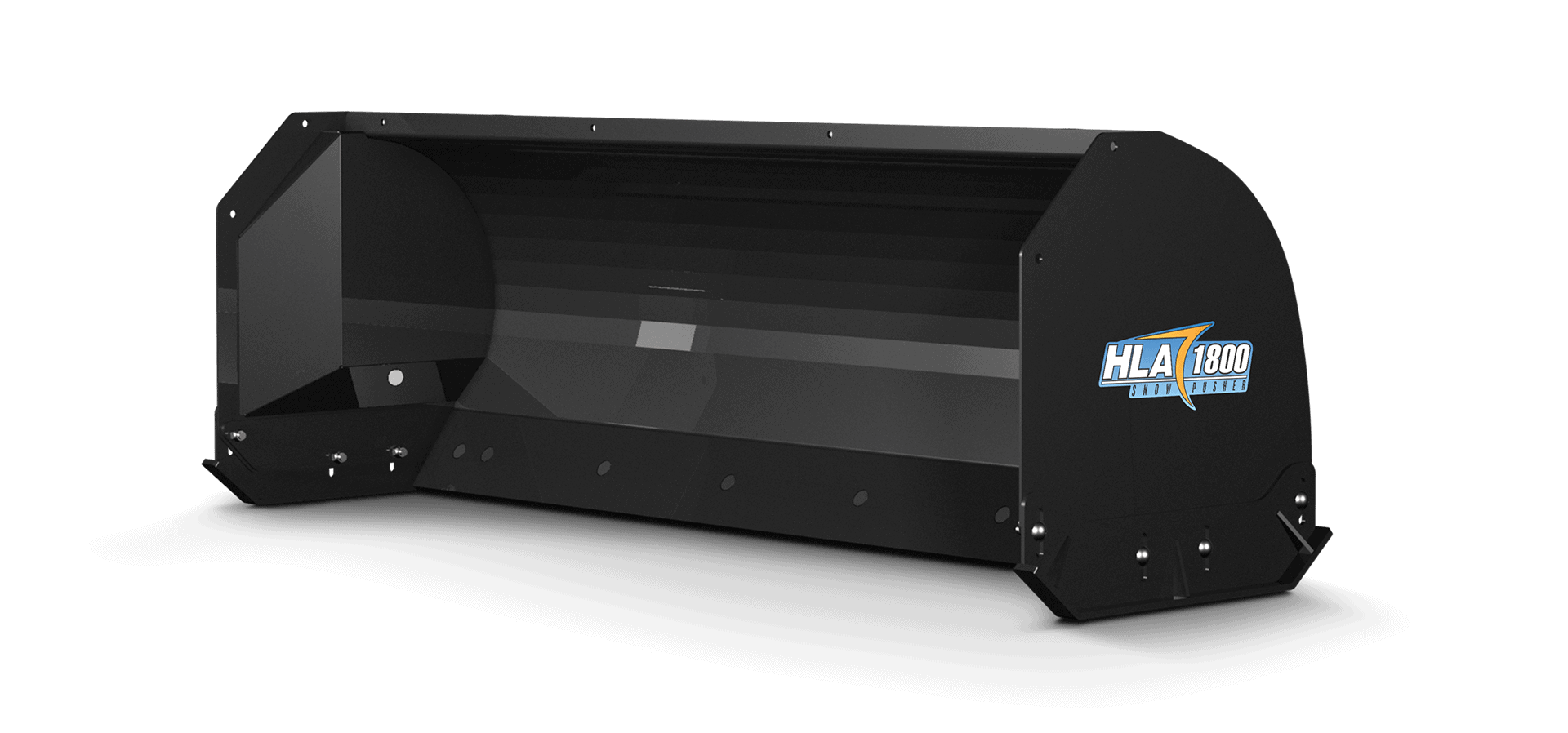
The HLA Snow Pusher 1800 Series is HLA Snow’s step-up pusher between the homeowner-class 1500 Series and the commercial-class 2500 Series — engineered specifically for the 2,000-4,000 lb operating weight class of larger compact tractors and small skid steers. Built in Wallenstein, Ontario by Horst Welding, the 1800 Series delivers more snow-handling capacity than the 1500 (taller 24-inch moldboard, deeper 21-inch end plates) while remaining sized appropriately for machines that haven’t yet stepped into commercial skid steer territory.
The 1800 Series fills a specific gap in HLA’s lineup: it’s the right pusher for mid-range compact tractors (Kubota L3302/L3902, John Deere 2032R, similar 30-37 HP machines) and smaller skid steers that exceed the 1500’s 3,000 lb limit but don’t yet need the 2500’s commercial-class construction. For Canadian buyers in this in-between size class, the 1800 Series typically delivers the best capability-per-dollar match.
Key features include the 24-inch tall moldboard (vs lower-profile 1500), 21-inch deep fixed end plates for better snow containment, welded double sidewall slim-brace design for reduced material build-up, AR400 high-tensile adjustable skid bars, replaceable reversible steel cutting edge, and the bolt-on attachment frame with 3 angle settings (80°, 90°, 100°) that allows operators to dial in optimal pushing angle for their specific conditions.
Available in 60″, 72″, and 84″ widths, the 1800 Series spans from larger compact tractors through small skid steers — covering the meaningful middle of the compact equipment market. Canadian pricing typically ranges $1,400-$2,200 CADdepending on width and options.
On Aglist, this page goes beyond HLA’s brochure to help Canadian buyers understand when the 1800 Series is the right choice over stepping down to the 1500 or up to the 2500, how the 3-angle mounting frame works in real operation, and which compact tractors and skid steers pair best.
Aglist advantage: Use the 1800 Series Reviews & Ratings section below to compare real Canadian owner feedback on mid-range compact tractor performance, the 3-angle mounting frame, and long-term value vs OEM Frontier/Land Pride pushers in this size class.
On This Page
ToggleQuick Specs
- Equipment type: Step-up compact tractor / small skid steer snow pusher
- Manufacturer: HLA Snow / Horst Welding (Wallenstein, Ontario, Canada)
- Series: 1800 SnowPusher
- Compatible machines: Mid-range compact tractors, small skid steers, large compact tractors
- Target machine operating weight: 2,000 to 4,000 lb
- Available widths: 60″, 72″, 84″
- Moldboard height: 24 inches
- End plate depth: 21 inches (fixed)
- Construction: Welded double sidewall slim-brace design
- Skid shoes: AR400 high-tensile adjustable steel skid bars
- Cutting edge: Replaceable, reversible steel (rubber and UHMW options available)
- Attachment frame: Bolt-on with 3 angle settings (80°, 90°, 100°)
- Back-drag: Optional integrated back-drag with steel edge
- Mounting options: Universal SSL Quick-Tach, JDQA (John Deere Quick Attach), other major loader styles
- Country of manufacture: Made in Canada
- Warranty: HLA Snow standard warranty
Reviews & Ratings on Aglist
Factory specifications tell you what the HLA SnowPusher 1800 Series is engineered to do. Real owner reviews tell you whether HLA’s mid-range pusher delivers the capability gap between the 1500 and 2500 with real-world value.
What 1800 Series buyers consistently want to know:
- Is the step up from the 1500 to the 1800 worth the price premium for a 30 HP compact tractor?
- How does the 24-inch moldboard handle heavy snow compared to the 1500’s lower profile?
- Does the 3-angle mounting frame (80°/90°/100°) actually matter in daily operation?
- What width works for my specific tractor (L3302, L3902, 2032R, 2038R)?
- Real-world cutting edge wear life on residential and light commercial duty?
- How does the 1800 perform on small skid steers like the SSV65 vs on a larger compact tractor?
This is where real Canadian owner experience matters most. The 1800 Series sits in HLA’s “in-between” position — bridging homeowner pricing with commercial capability. Owner reviews on this page help future buyers understand whether the 1800 is the right step up from the 1500, or whether stepping further up to the 2500 makes more sense.
What Makes the 1800 Series Different
Three engineering decisions define the 1800 Series within HLA’s SnowPusher lineup.
Taller Moldboard for More Snow Containment
The 1800’s 24-inch moldboard is meaningfully taller than the 1500 Series — delivering more snow containment per pass. For mid-range compact tractors and small skid steers operating in heavier Canadian snow conditions, this additional height matters:
- Carries more snow per push without overflow at the top
- Contains rolled snow better as you push longer distances
- Provides more visible reference at the operator’s seat
- Improves stacking at the end of clearing runs
Combined with the 21-inch fixed end plates, the 1800 Series traps and contains substantially more snow than the smaller 1500 Series — appropriate for machines that have enough HP and weight to push the larger volume.
Slim-Brace Double Sidewall Construction
HLA’s signature welded double sidewall construction takes a specific form on the 1800 Series — a slim-brace designthat maintains structural strength while reducing material build-up internally. The benefits:
- No bulky internal cross-bracing that traps snow and ice
- Smooth interior surfaces that release snow cleanly with each push
- Stronger structural integrity than single-wall + heavy-brace designs
- Better long-term durability with optimized welding geometry
This construction approach is HLA’s standard across the SnowPusher line; the 1800 Series implementation is specifically optimized for the mid-range size class.
Bolt-On Attachment Frame with 3 Angle Settings
The 1800 Series is notable for its bolt-on attachment frame with 3 angle settings (80°, 90°, 100°) — allowing operators to dial in the optimal pushing angle for their specific conditions:
- 80° — aggressive forward lean, best for packed snow and heavier scraping
- 90° — neutral position, most common setup for typical conditions
- 100° — backward lean, better for clean pavement protection and light snow
For operators who experience varied snow conditions through a season (early winter light snow, mid-winter packed snow, spring slush), the 3-angle setting allows optimization without changing attachments. Many competitor pushers at this size class have fixed-angle frames — the HLA 1800’s adjustability is a meaningful daily-operation advantage.
3-Angle Mounting Frame
The 3-angle mounting frame deserves its own discussion — it’s one of the 1800 Series’ most-useful features that’s easy to overlook on the spec sheet.
How the 3 Angles Work
The bolt-on attachment frame can be mounted in three discrete positions:
80° (Forward-Leaning):
- Cutting edge engages the surface aggressively
- Best for scraping packed snow, ice, hardpack
- Maximum scraping pressure
- Used by operators in cold-climate regions with frozen surfaces
90° (Neutral):
- Cutting edge sits perpendicular to the surface
- Most common setup for typical conditions
- Balanced scraping force
- Default position for most operators
100° (Backward-Leaning):
- Cutting edge engages surface lightly
- Best for clean pavement protection
- Minimal surface scratching
- Used for decorative concrete, stamped surfaces, light fresh snow
When to Switch Settings
Most operators set the angle once at the start of the season based on their primary surface and snow conditions. Switching mid-season is straightforward but requires bolt removal and reattachment at the new angle — not designed for daily switching.
Common setup patterns:
- Prairie operators (Saskatchewan, Alberta): 80° for packed snow and frozen surfaces
- Ontario / Quebec residential: 90° for typical mixed conditions
- BC / Maritime coastal: 90° or 100° for wet snow on concrete and asphalt
- Decorative surfaces year-round: 100° to minimize surface contact
Sizing the 1800 Series
The 1800 Series is available in three widths matched to compact tractor and small skid steer operating weights.
Sizing Recommendations
| Width | Recommended Tractor Class | Typical HP | Operating Weight |
|---|---|---|---|
| 60″ | Larger compact tractors (entry to 1800) | 30-35 HP | 2,000-2,800 lb |
| 72″ | Mid-range compact tractors | 33-40 HP | 2,500-3,500 lb |
| 84″ | Small skid steers, large compact tractors | 35-45 HP | 3,000-4,000 lb |
Specific Tractor & Skid Steer Recommendations
For Canadian buyers with specific machines, here’s HLA’s typical recommendation based on owner experience:
- John Deere 2032R (30.7 HP): 60″ or 72″ width 1800 (depending on snow conditions)
- John Deere 2038R (36.7 HP): 72″ width 1800
- Kubota L3302 (~33 HP): 60″ or 72″ width 1800
- Kubota L3902 (37.5 HP): 72″ width 1800
- Kubota L4802 (49 HP): 72″ or 84″ width 1800 — for L4802 also consider stepping up to 2500
- Small skid steers (Kubota SSV65 entry, similar machines under 4,000 lb): 72″ or 84″ width 1800
For broader sizing guidance and brand comparison covering all snow pusher options, see our Snow Pushers for Skid Steers buyer’s guide.
Don’t Oversize
The 1800 Series caps at 4,000 lb operating weight for a reason — operators frequently make the mistake of installing the 84″ width on machines that can’t effectively push it through heavy snow. The result: stalling, wheel slip, accelerated wear, and frustrating operation.
If you’re unsure between sizes, go with the smaller width — you can always make multiple passes with a smaller pusher more efficiently than struggling with an oversized one.
Cutting Edge & Skid Bar Options
The 1800 Series accepts the same cutting edge configurations as the larger 1500 and 2500 Series.
Cutting Edge Options
Reversible steel cutting edge (standard): Aggressive scraping, long wear life (typically 200-500 hours residential use, doubled by reversing). Best for gravel surfaces, packed snow, and ice. Will scratch concrete and asphalt over time.
Rubber cutting edge (option): Gentle scraping, protects pavement surfaces. Best for clean residential concrete and asphalt driveways. Shorter wear life than steel (typically 150-300 hours).
UHMW (polyurethane) cutting edge (option): “Cuts like steel, but protects like rubber.” Best total value for mixed-surface operations. Higher initial cost; long wear life. Increasingly the preferred choice for residential/light-commercial operators with mixed pavement and gravel.
Skid Bar Adjustments
The AR400 high-tensile adjustable skid bars can be raised or lowered to control cutting edge contact with the surface:
- Skid bars low (cutting edge raised): Surface protection, less aggressive scraping
- Skid bars at neutral: Cutting edge contacts surface lightly
- Skid bars high (cutting edge lowered): Aggressive scraping, faster cutting edge wear
For most residential applications, adjust skid bars to keep the cutting edge just barely off the surface — typically 1/8 to 1/4 inch above. This protects the pavement while still cutting accumulated snow effectively.
Back-Drag Option
The 1800 Series accepts the optional integrated back-drag — a steel edge mounted on the back of the pusher that pulls snow when you reverse the tractor or skid steer.
The back-drag is particularly useful for:
- Pulling snow away from garage doors without scraping the door
- Clearing along walls where forward pushing can’t reach
- Removing snow from corners of driveways and parking areas
- Pulling snow back from parked vehicles or fixed obstacles
The HLA back-drag is fully integrated with the pusher structure (not bolted on as an afterthought). The base back-drag includes a steel edge; optional rubber or UHMW back-drag cutting edges are available for pavement protection.
For most homeowner and acreage operations, the back-drag is worth specifying at purchase. Adding it later costs more than getting it factory-installed.
Best Applications for the 1800 Series
The HLA 1800 Series fits a specific operational profile.
Best fit for the 1800 Series:
- Mid-range compact tractor owners (30-40 HP, 2,000-3,500 lb operating weight)
- Small skid steer operators in the 3,000-4,000 lb class
- Acreage properties with significant pavement and varied snow conditions
- Hobby commercial operations doing light snow contracting on side
- Operators who’ve outgrown the 1500 Series with smaller tractors
- Buyers preferring the 3-angle frame adjustability over fixed-angle competitors
- Mixed-surface properties benefiting from the larger moldboard’s snow containment
Best fit with UHMW cutting edge + rubber back-drag:
- Properties with decorative concrete or stamped driveways
- Operators valuing pavement protection over maximum scraping aggressiveness
- Mixed pavement and gravel operations needing balanced performance
Best fit with back-drag option:
- Properties with garage doors or wall edges that need back-drag clearing
- Operations clearing along curbs, corners, and tight quarters
- Buyers planning multi-year ownership where back-drag use accumulates value
Less suitable for:
- Sub-compact tractors (under 25 HP) — step down to HLA 1500 Series
- Smaller compact tractors (under 30 HP, under 2,000 lb operating weight) — 1500 is better fit
- Mid-frame commercial skid steers (over 4,000 lb operating weight) — step up to HLA 2500 Series
- Heavy commercial operations — 2500 or 3500 Series provides appropriate commercial-grade construction
The honest assessment: the 1800 Series is the right answer for operators stepping up from sub-compact tractors to mid-range compact tractors or small skid steers. It bridges the homeowner-class 1500 and the commercial-class 2500 with appropriate capability — without paying for commercial features (Edge Flex, carbide edges) that smaller machines don’t need.
1800 vs 1500 vs 2500
The 1800 Series sits between two popular HLA SnowPusher models. Here’s how it compares:
| Feature | 1500 Series | 1800 Series | 2500 Series |
|---|---|---|---|
| Target Operating Weight | Up to 3,000 lb | 2,000-4,000 lb | 3,500-6,000 lb |
| Available Widths | 54″-72″ | 60″-84″ | 6-10 ft |
| Moldboard Height | Standard | 24 inches | 30 inches |
| End Plate Depth | Standard | 21 inches | Standard |
| Welded Double Sidewall | Yes | Yes (slim-brace) | Yes |
| AR400 Skid Shoes | Yes | Yes | Yes |
| 3-Angle Mounting Frame | Some configurations | Yes (80°/90°/100°) | Some configurations |
| Reversible Steel Edge | Yes | Yes | Yes |
| Rubber/UHMW Edge Options | Yes | Yes | Yes |
| Edge Flex Option | No | No | Yes (optional) |
| Carbide Edge Option | No | No | No |
| 2-Year Commercial Warranty | Standard | Standard | Standard |
| Approx CAD Price (with steel edge) | $1,000-$2,000 | $1,400-$2,200 | $3,500-$6,500 |
Choose the 1500 Series if your machine is under 3,000 lb operating weight (sub-compact tractors and lighter compact tractors).
Choose the 1800 Series if your machine is 2,000-4,000 lb operating weight (mid-range compact tractors and small skid steers). Significant capacity improvement over 1500 at modest price premium.
Choose the 2500 Series if your machine is 3,500-6,000 lb operating weight (commercial skid steers). Substantially heavier-duty construction for commercial duty cycles.
For broader HLA Snow brand information, see the HLA Snow brand page.
Maintenance & Long-Term Ownership
The 1800 Series has a simple maintenance profile — primarily structural steel with no hydraulic components.
Routine maintenance:
- Cutting edge inspection after each storm; replace when thickness reduced by 50%
- Skid bar inspection monthly; AR400 bars typically last multiple seasons
- Pivot point lubrication monthly during season
- Mounting hardware inspection at each storm; verify the 3-angle frame is securely bolted
- Powder-coat inspection annually; touch up bare-metal areas
Typical wear part replacement costs:
- Steel cutting edge (reversible): $130-220 CAD per replacement (typically every 200-500 hours, doubled by reversing)
- Rubber cutting edge: $130-240 CAD per replacement (150-300 hours)
- UHMW cutting edge: $220-380 CAD per replacement (300+ hours)
- AR400 skid bars: $180-300 CAD per pair (typically last multiple seasons)
Long-term ownership:
- Welded steel construction typically lasts 15-20+ years with proper care
- Wear parts replaced periodically through service life
- Strong resale value due to HLA brand recognition
- The 1800 Series holds value well in the Canadian used market
Frequently Asked Questions
Where can I read HLA SnowPusher 1800 reviews and ratings?
On Aglist, the Reviews & Ratings section helps Canadian buyers compare owner feedback, real operating experience, and long-term ownership impressions before choosing the 1800 Series.
Is the HLA 1800 made in Canada?
Yes. HLA Snow manufactures the SnowPusher 1800 Series in Wallenstein, Ontario, as part of Horst Welding’s broader Canadian manufacturing operation.
What’s the difference between the HLA 1500 and 1800 Series?
The 1500 targets sub-compact and small compact tractors (under 3,000 lb operating weight) with widths from 54″-72″. The 1800 targets mid-range compact tractors and small skid steers (2,000-4,000 lb operating weight) with widths from 60″-84″, a taller 24-inch moldboard, deeper 21-inch end plates, and the 3-angle bolt-on mounting frame. The 1800 typically costs $400-700 CAD more than equivalent 1500 widths.
What size HLA 1800 do I need for my John Deere 2032R?
The John Deere 2032R (30.7 HP, mid-range 2 Family compact tractor) is well-matched to either the 60″ or 72″ width 1800 depending on snow conditions. Operators in lighter snow regions typically choose the 72″ for maximum clearing capacity; operators in heavier snow regions or with limited counterweight stay with the 60″ for easier handling.
What size HLA 1800 do I need for my Kubota L3902?
The Kubota L3902 (37.5 HP, mid-range L02 series) is well-matched to the 72″ width 1800. The L3902’s higher HP and operating weight can handle the larger pusher effectively. Some operators with significant counterweight successfully use the 84″ — but 72″ is the most-common installation.
What’s the 3-angle mounting frame?
The 1800 Series uses a bolt-on attachment frame that can be mounted in three discrete angle positions: 80° (forward-leaning, aggressive scraping), 90° (neutral, default), and 100° (backward-leaning, surface protection). Operators set the angle based on their primary surface and snow conditions. This adjustability is unusual in the price class — most competitor pushers use fixed-angle frames.
Should I get the back-drag option?
For most homeowner and acreage operations, yes. The back-drag is significantly cheaper to add at purchase than retrofit later, and most properties benefit from at least one location where back-drag clearing matters (garage doors, walls, corners).
How does the HLA 1800 compare to OEM Frontier or Land Pride pushers?
The HLA 1800 typically delivers better long-term value than OEM Frontier (John Deere) and Land Pride (Kubota) pushers in this size class. HLA’s welded double sidewall, AR400 skid bars, 3-angle mounting frame, and reversible cutting edges are features that OEM alternatives at similar pricing typically don’t match. The 1800 also offers better width options (84″ available) and more cutting edge alternatives (rubber, UHMW) than most OEM equivalents.
What’s the typical price of an HLA 1800 SnowPusher in Canada?
As of 2026, the HLA 1800 typically ranges (steel cutting edge):
- 60″ width: $1,400-$1,800 CAD
- 72″ width: $1,700-$2,000 CAD
- 84″ width: $1,900-$2,400 CAD
Adding the back-drag adds approximately $300-500 CAD. Adding UHMW cutting edges adds approximately $250-400 CAD. Adding the skid steer mount or John Deere quick-attach mount adds approximately $300-400 CAD. Confirm current pricing with your local HLA dealer — Canadian listings at Maxwell Farm Service and similar dealers show recent 1800 Series pricing.
How long does an HLA 1800 SnowPusher last?
The structural pusher (moldboard, side walls, frame) typically lasts 15-20+ years with proper care. Wear parts (cutting edges, skid bars) are replaced periodically. Many residential and light-commercial operators run the same HLA 1800 for 10-15+ years with only periodic wear part replacement.
Can the HLA 1800 mount to my older John Deere tractor without quick-attach?
Yes — HLA offers John Deere tractor mounting frame options for the 1800. Confirm specific compatibility with your tractor model with your HLA dealer; older tractors may require specific configurations or adapter brackets.
Does the 1800 Series work in heavy snow conditions?
Within its size class, yes. The 24-inch moldboard and 21-inch end plates contain meaningful snow volume per pass. For consistently heavy snow conditions (12+ inches typical accumulations), partial-width passes maintain traction better than attempting full-width clearing. For very heavy commercial snow operations (16+ inch storms common), consider stepping up to the larger HLA 2500 Series with a commercial skid steer.
Can the HLA 1800 work on a 3-point hitch for rear pulling?
The 1800 Series is primarily designed for front-mount loader operation. Rear-mount 3PH configurations may be available with specific brackets — verify with your dealer for your specific tractor.
Reviews & Ratings on Aglist
Share your experience
Similar Equipment
- HLA SnowPusher 1500 — homeowner pusher for sub-compact and compact tractors (under 3,000 lb)
- HLA SnowPusher 2500 — commercial pusher for skid steers (3,500-6,000 lb)
- HLA Snow — brand catalog with complete product lineup
Note: We try our best to keep specs and information accurate, but some details can be missing or different depending on the source. Before you buy, service, or repair equipment, please double-check key specs with the manufacturer, the owner’s manual, or your dealer.
About reviews: Reviews on Aglist are written by real users. We moderate them for spam and abuse, but opinions and claims are still personal—so use them as guidance, not as a guarantee.
Share your experience
Help other Canadian buyers — leave a quick review for the
HLA Snow Pusher 1800
There are no reviews yet. Be the first one to write one.


