
Overview & Specs
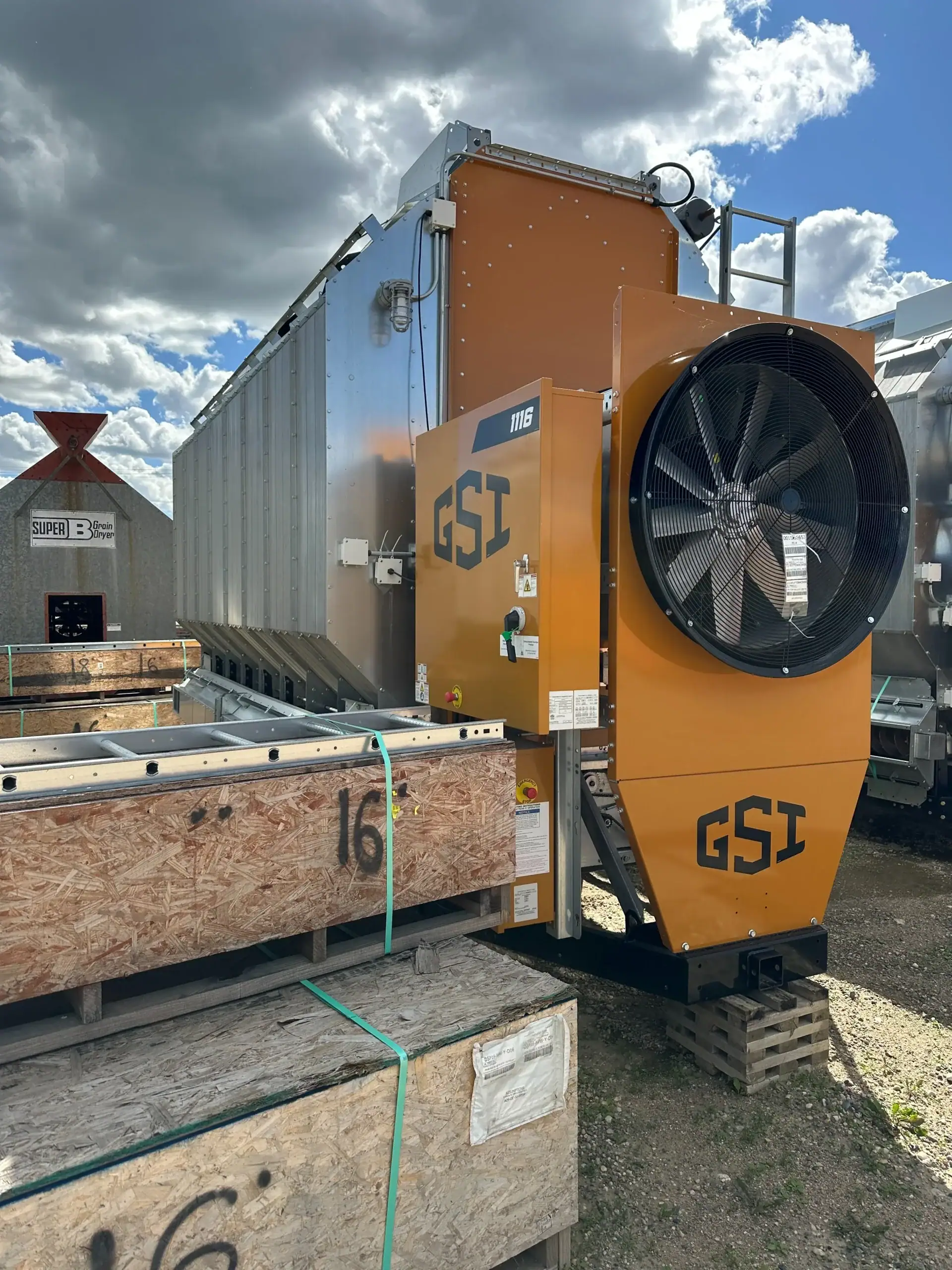
GSI 1116 Grain Dryer
On This Page
ToggleA stronger mid-range option in the GSI 1100 Series
The GSI 1116 Grain Dryer is part of GSI’s 1100 Series of portable dryers, a lineup built around a single-module, single fan and heater, single-plenum design. GSI positions this series for small- to medium-sized farms, especially operations using bins of 50,000 bushels or less with adequate cooling air, and describes the 1100 family as a strong fit for a first high-speed dryer.
For Aglist users, the 1116 stands in an attractive part of the range. It gives a noticeable jump in output over the smaller 1108, 1112, and 1114 models, but it still keeps the simpler fixed-format layout that defines the 1100 Series. That makes it a practical candidate for farms that want more drying room during harvest without stepping into a larger multi-module dryer platform.
Where the GSI 1116 fits in the 1100 Series
The official 1100 Series lineup includes 1108, 1112, 1114, 1116, 1118, 1120, 1122, and 1126. GSI also states that this series is not expandable, so the 1116 should be treated as a fixed-capacity portable dryer rather than a modular system intended for later add-ons. Across the series, GSI lists roughly 420 to 1,160 BPH all-heat drying at 5-point removal, placing the 1116 in the middle of the family rather than at the entry or top end.
That positioning matters. The 1116 is the kind of model farms often consider when they want more harvest flexibility than the smaller units can offer, but still want a dryer that is easier to understand, easier to place, and more realistic to power than a much larger system. This is one of the main reasons the 1100 Series works well on Aglist as a comparison-friendly family.
GSI 1116 drying performance
According to GSI’s published portable dryer brochure, the GSI 1116 Grain Dryer is rated at 710 BPH in Full Heat 20% to 15%, 440 BPH in Full Heat 25% to 15%, and 320 BPH in Full Heat 30% to 15%. In Dry and Cool staged batch, it is rated at 370 BPH at 20% to 15% and 280 BPH at 25% to 15%.
Those numbers place the 1116 as a meaningful step above the smaller 1114. For farms where wet harvest conditions, labour timing, or trucking flow can create pressure, the extra capacity can help create a more comfortable buffer. In real buying decisions, that often matters more than simply choosing the cheapest dryer that technically works.
Capacity, construction, and size
GSI lists the 1116 as 1 module and 1 stage. In the specification table, total holding capacity is shown at 436 bushels, with 376 bushels of grain column holding capacity. The same source shows the 1116 using a 40-inch fan with 15 HP in the 1100 Series specification layout.
In the transport and installation dimensions table, the 1116 is listed with a transport height of 13’5”, transport width of 8’, installed height of 14’6”, installed length of 23’2”, and transport length of 25’2”.
For Canadian farms, those physical numbers are not secondary details. Dryer footprint, yard planning, and transport access can all influence whether a machine fits the site smoothly or creates extra installation headaches. A dryer may look right on paper for capacity, but size and service requirements still shape the final decision.
Augers, unloading, and grain handling
In the GSI 1100 Series specification chart, the 1116 is listed with an 8-inch top auger, 5 HP, an 8-inch bottom auger, 5 HP, and a top auger handling figure of 3,800 BPH. The meter roll drive is shown as SCR, 3/4 HP, and the maximum discharge rate is listed at 2,240 BPH, with GSI noting that actual discharge rate is controlled by meter roll speed adjustment from 5% to 100% of maximum rate.
These details are useful because dryer performance in the field is not only about burner size or one drying-capacity number. Feed consistency, unload management, and how the grain moves through the unit can strongly affect how practical the machine feels during harvest.
Heater, fuel, and electrical details
In GSI’s portable dryer brochure, the 1116 is listed with a heater rated at 5.75 million BTU/hr. The brochure also shows 10–16 HP, 40-inch fan for single-phase and 15 HP, 40-inch fan for three-phase on the 1116 line.
In the ETL-listed manual, GSI’s LP fuel chart lists the 116/1116/370 at 5,750,000 BTU per hour, with 63 gallons per hour maximum fuel flow, while the natural gas chart lists the same model at 5,750 cubic feet per hour maximum fuel flow. In the electrical-load table for the 1100 Series, the 1116 is shown at 108 amps for 1 phase, 220 volt, 65 amps for 3 phase, 220 volt, 33 amps for 3 phase, 440 volt, 27 amps for 3 phase, 575 volt, and 44 amps for 3 phase, 380 volt, excluding auxiliary load and unload conveyor equipment.
That is the kind of information buyers should pay close attention to before choosing a model. Electrical service and fuel setup can influence site cost just as much as the purchase price, especially when comparing several dryers that all seem close on capacity.
Drying style and crop-use flexibility
GSI says the 1100 Series is primarily an all-heat corn drying system, but also notes that it can be used in Continuous Batch Dry & Cool operation either full-time or in specific situations, such as putting a dry cone in a flat-bottom wet bin or handling occasional soybean or wheat drying while still delivering cooled grain.
That gives the 1116 more flexibility than a basic category label might suggest. It is still important to match the dryer to the farm’s crop mix, moisture targets, storage airflow, and harvest pace, but the official GSI wording makes it clear that the model is not restricted to just one narrow operating scenario.
What makes the GSI 1116 attractive to buyers
From an Aglist perspective, the GSI 1116 Grain Dryer stands out because it hits a useful middle point: enough output to feel like a meaningful upgrade, but still inside a simpler single-module portable design. That balance can be attractive for growers who want a serious on-farm drying step without overcommitting to a larger class of equipment too early.
It can be especially appealing for farms that want a first high-speed dryer with more breathing room than the smallest models, while still keeping installation, yard footprint, and system complexity in a range that feels practical.
Real-world buying questions
Is the GSI 1116 enough for a mid-sized grain operation?
It can be, depending on acreage, harvest pace, crop moisture, labour, and storage airflow. On paper, the 1116 offers a substantial step up from the smaller 1100 Series dryers, with 710 BPH at 20% to 15% in Full Heat and 436 bushels total holding capacity.
Is the 1116 still a good first dryer?
Yes. That matches how GSI positions the 1100 Series overall. The company describes the range as suited to smaller and medium-sized farms and specifically frames it as a good first high-speed dryer.
Can it work for crops besides corn?
GSI says yes, in the right setup. While the 1100 Series is mainly presented as an all-heat corn dryer, GSI also mentions occasional soybean or wheat drying in Dry & Cool operation when cooled grain is needed.
Final thoughts
The GSI 1116 Grain Dryer is a strong fit for farms that want more capacity than the smaller 1100 Series models while keeping the same practical single-module concept. With published output up to 710 BPH at 20% to 15% in Full Heat, 436 bushels of total holding capacity, and a portable design aimed at small- to medium-sized farms, it fills a very useful spot in the GSI lineup.
For Aglist, this page works best as a model-focused resource built around specifications, farm-fit decisions, buyer comparison, and later owner feedback. It is exactly the kind of model where real user impressions can add value beyond the brochure numbers.
GSI 1116 Reviews & Ratings
Share your experience
Help other Canadian buyers — leave a quick review for the
GSI 1116
There are no reviews yet. Be the first one to write one.


