
Overview & Specs
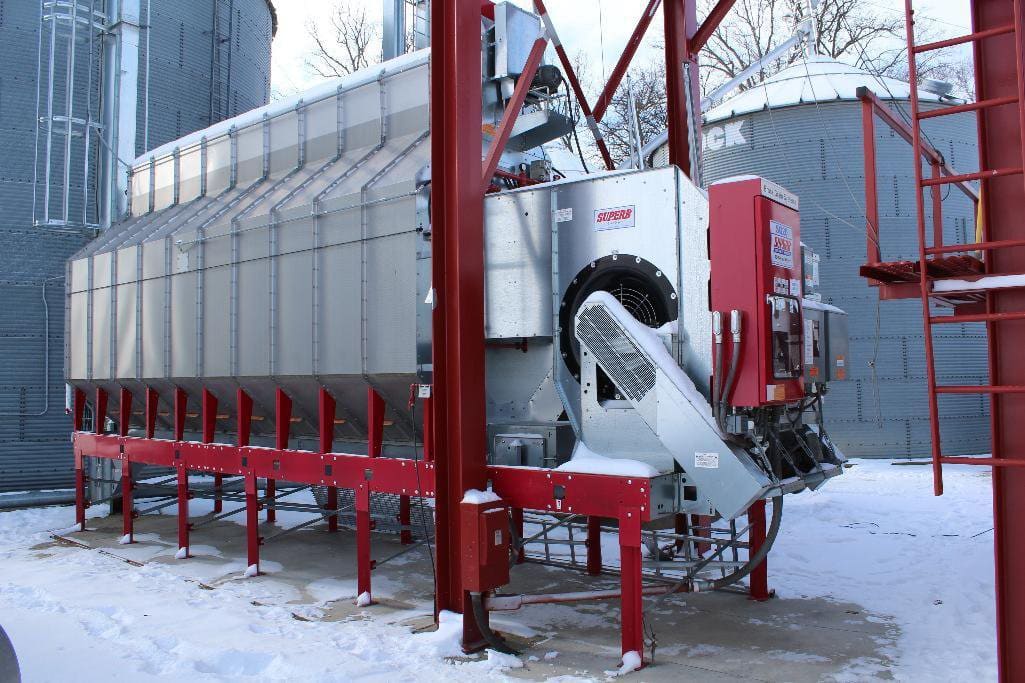
Super-B SQ20 Continuous-Flow Grain Dryer
The Super-B SQ20 is the mid-range model in the SUPER-B Energy Miser SQ Series — the natural step up from the SQ16 for prairie operators who need more drying capacity than a typical single-combine setup demands, but who don’t yet need the full footprint and capital cost of an SQ24. With 408 bushels of holding capacity, a 20-foot 5-inch grain column, and a 20 HP fan, the SQ20 fills the practical gap between the SQ16 and SQ24 for large single-combine operations and small two-combine farms.
The SQ20 is the model most often selected by operators who started with an SQ12 or SQ16 and outgrew it within 3–5 years, but whose current operation still doesn’t justify stepping all the way up to the SQ24. It’s also the model most often selected by farms running a single Class 9 combine — where peak combine output meaningfully exceeds what an SQ16 can sustain on tough crops.
For prairie operations between approximately 1,500 and 3,500 acres of mixed crops, the SQ20 frequently delivers the best capacity-to-cost ratio in the Super-B lineup.
On This Page
ToggleSQ20 Configuration Choice — D, E, A, or M
The SQ20 is offered in four standard configurations defined by the letter suffix after the model number. All four share identical grain column dimensions, holding capacity, and core drying technology — the differences are in drying mode capability and fuel-efficiency features.
SQ20D — Full Heat (Single Zone)
Continuous-flow full-heat operation with one temperature throughout the column. Grain leaves the dryer hot and is cooled in-bin afterward. Lowest capital cost in the SQ20 frame.
Best for: Single-crop operations where in-bin cooling capacity is well-established and mode flexibility is not a priority. Less common on mixed-crop prairie farms.
SQ20E — Continuous Flow with Louvers
Adds adjustable cooling louvers enabling three drying modes: full heat, pressure heat / pressure cool, and pressure heat / vacuum cool. The most-installed configuration of the SQ20 on prairie farms.
Best for: Mixed-crop prairie operations handling wheat, canola, oats, and pulses where mode flexibility is needed. The standard recommendation for typical 1,500–3,500 acre operations.
SQ20A — Continuous Flow with Hot Air Return Duct
Adds the hot air return duct for heat recovery — Super-B’s “Energy Miser” feature delivering up to 20% lower fuel consumption during continuous operation. On the SQ20, the configuration premium typically pays back in 4–6 years for operations drying 30,000+ bushels per season.
Best for: Higher-volume operations drying 30,000+ bushels per season, custom drying businesses, and long-term ownership scenarios where fuel cost matters.
SQ20M — Two-Temperature-Zone
Uses two distinct temperature zones for full-heat or pressure-heat / pressure-cool drying. Designed for operations needing precise temperature staging.
Best for: Seed-grade producers, malting barley operations, and pulse processors where temperature control directly affects grade-out and crop value.
Key Specifications
| Specification | Value |
|---|---|
| Series | SUPER-B Energy Miser SQ Series |
| Configuration | Single-module continuous flow |
| Total Fan HP | 20 HP |
| Auger Load HP | 5 HP |
| Chain Unload HP | 2 HP |
| Column Length | 20′ 5″ |
| Overall Length | 31′ 3″ |
| Overall Height | 14′ 2″ |
| Total Holding Capacity | 408 BU |
| Configurations Available | D (Full Heat), E (Louvers), A (Energy Miser), M (Two-Zone) |
| Fuel | LP or Natural Gas |
| Burner | Brock full flame-wall with stainless steel baffles |
| Blower | Double-width, double-inlet centrifugal (standard) |
| Grain Column | Variable-width (narrower top, wider bottom) |
| Outer Skins | 18-gauge stainless steel perforated |
| Unloading | EVENFLO drag-chain conveyor |
| Standard Controls | QUANTUM or SPECTRUM |
| Optional Controls | INTUI-DRY 15.6″ touchscreen with remote access |
| Plenum Door | 42″ × 22″ vertical access with safety shutdown switch |
Drying Capacity by Crop and Mode
All capacities below are wet bushels per hour. Standard reference (corn 25.5%→15.5%) is published by Brock for cross-model comparison. Prairie crop capacities vary with grain temperature, ambient temperature, fines content, and crop maturity.
Corn Capacity (Manufacturer Standard Reference)
| Mode | Moisture Removal | Capacity (BPH) |
|---|---|---|
| Full Heat – Single Zone (Model D) | 25.5% to 15.5% (10 points) | 591 |
| Full Heat – Single Zone (Model D) | 20.5% to 15.5% (5 points) | 976 |
| Modified Full Heat – Single Zone (Models M, E, A) | 25.5% to 15.5% | 568 |
| Modified Full Heat – Single Zone (Models M, E, A) | 20.5% to 15.5% | 938 |
| Pressure Heat – Two-Zone (Model M) | 25.5% to 15.5% | 535 |
| Pressure Heat – Two-Zone (Model M) | 20.5% to 15.5% | 873 |
Approximate Prairie Crop Capacity (Practical Estimates)
| Crop | Moisture Removal | Approximate Capacity (BPH) |
|---|---|---|
| Hard Red Spring Wheat | 16% → 14.5% (1.5 points) | 2,000–2,600 |
| Wheat | 18% → 14.5% (3.5 points) | 1,150–1,500 |
| Canola (crush grade, 82°C max) | 12% → 8% (4 points) | 900–1,200 |
| Canola (seed grade, 45°C max) | 12% → 8% (4 points) | 450–650 |
| Oats | 16% → 14% (2 points) | 1,400–1,900 |
| Yellow Peas | 18% → 16% (2 points) | 1,000–1,400 |
These prairie-crop estimates are derived from the published corn ratings and typical efficiency factors for each crop. Always confirm capacity for your specific crop, moisture differential, and ambient conditions with your dealer before sizing.
Fan & Heater Configuration
The SQ20 runs a single 20 HP centrifugal blower — a step up from the SQ16’s 15 HP fan but still lower than the SQ24’s 25 HP. The double-width, double-inlet centrifugal blower design provides:
- Significantly lower noise than axial fans found on most competitors and earlier Super-B models
- Higher static pressure capability for consistent airflow through the SQ20’s 20′ 5″ grain column
- Better energy efficiency at the SQ20’s drying capacity than equivalent axial designs
The 20 HP rating is well-matched to the SQ20’s column length and drying capacity. Operators report consistent airflow performance even on high-throughput days when the dryer runs at maximum continuous capacity.
The trade-off, common to all centrifugal-blower SQ Series units, is that the fan can ice up in extreme cold (typically below approximately –17°C) and may require a thaw-out cycle. For most prairie harvests this is rarely a daily issue. Late-October and early-November drying in northern Alberta and Saskatchewan occasionally requires interrupting drying briefly to clear ice from the fan housing.
The Brock full flame-wall burner with stainless steel baffles distributes heat evenly across the SQ20’s grain column. The plenum geometry is designed to deliver uniform plenum temperatures across the full column length — important on the SQ20 because the longer column has greater potential for front-to-back temperature variation than shorter models.
The SQ20 is configured for either liquid propane (LP) or natural gas (NG) at order. For SQ20-class operations drying 25,000+ bushels per season, the long-term fuel cost difference between propane and natural gas is meaningful. If natural gas is available at your yard for under approximately $25,000 connection cost, the math typically favors natural gas for SQ20 installations.
Grain Column & Holding Capacity
The SQ20 features Super-B’s variable-width grain column in a 20′ 5″ configuration. The geometry follows the same principle as smaller and larger SQ Series models — narrower at the top for efficient moisture removal, wider at the bottom for better dwell time — applied across a column length matched to the SQ20’s drying throughput.
Total holding capacity: 408 bushels — including the perforated wet garner bin at the top, the active grain column, and the discharge zone. The wet garner pre-warms incoming grain using exhaust heat from the lower drying chambers, beginning the drying process before grain enters the main column.
Stainless steel perforated outer skins (18-gauge) are standard. With proper maintenance — including thorough cleaning between crops and especially after canola — stainless skins typically outlast every other component on the dryer. Operators report 25–30+ year service life on the skin assemblies of well-maintained SQ Series units.
For drying canola or other small grains, the small grain screen option is essential. The SQ20’s higher throughput compared to smaller SQ Series models means more potential for screen plugging from canola fines — daily screen inspection during canola drying campaigns is non-negotiable.
Loading, Unloading & Metering (EVENFLO System)
The SQ20 uses Super-B’s patented EVENFLO drag-chain unloading system — the same fundamental design as smaller SQ Series models, scaled appropriately for the SQ20’s higher throughput.
Loading: A 5 HP top auger (versus 3 HP on the SQ16) feeds wet grain from your wet bin into the SQ20’s perforated wet garner. The 5 HP rating is sized to keep up with the SQ20’s drying capacity during peak operation without becoming a fill-rate bottleneck.
Unloading via EVENFLO: A slow-moving drag-style chain conveyor at the base of the dryer powered by a 2 HP variable-speed AC motor. Advantages over conventional metering-roll systems:
- Even unloading across the full column length — eliminates column-to-column flow imbalance
- Gentler grain handling — significantly less kernel damage during discharge, directly affecting pulse and oat grade-out
- Debris-tolerant — passes most foreign material that would jam an auger or metering roll
- Easier between-crop cleaning — removable top cover means crop changeovers happen faster
- Consistent metering — chain speed control delivers reproducible exit moisture
For prairie operations frequently switching between wheat, canola, oats, and pulses on the same machine, the EVENFLO’s clean-out advantage is a meaningful operational benefit.
Operating Modes
The SQ20 supports continuous-flow drying with mode capability dependent on configuration:
Full Heat (D, E, A, M configurations) — Maximum drying intensity. Grain exits the dryer hot and is cooled in-bin afterward. Highest published BPH ratings — 976 BPH on corn at 5-point removal. Best for high-throughput drying with adequate in-bin cooling capacity.
Pressure Heat / Pressure Cool (E, A, M configurations) — Cooling air pushed through the lower portion of the column. Grain exits cooled and ready for direct binning. The most-used mode on prairie operations because it eliminates in-bin cooling complexity.
Pressure Heat / Vacuum Cool (E, A configurations) — Cooling air pulled through the lower column via vacuum. Different airflow characteristics than pressure cool.
Two-Zone Pressure Heat (M configuration only) — Hotter top zone for moisture removal, cooler bottom zone for finishing. Used for sensitive crops including seed-grade canola, malting barley, and premium pulses.
For most prairie SQ20 buyers, the E configuration with pressure cool mode covers virtually every drying scenario. The A configuration is increasingly popular on larger SQ20 installations where annual fuel consumption justifies the heat-recovery payback.
Transport & Installed Dimensions
| Dimension | Value |
|---|---|
| Overall Length | 31′ 3″ |
| Overall Height | 14′ 2″ |
| Overall Width (varies by config) | Approximately 10′ 0″ |
| Total Fan HP | 20 |
| Auger Load HP | 5 |
| Chain Unload HP | 2 |
The SQ20 is designed primarily as a fixed installation. While relocation is possible with appropriate heavy-haul equipment, most prairie installations are permanent — set on a reinforced concrete pad with three-phase electrical service and supporting infrastructure.
Concrete pad requirement: The SQ20 requires a properly engineered reinforced concrete pad sized for the dryer’s operating weight plus full grain load. Confirm specifications with your dealer and local engineer based on soil conditions.
Three-phase electrical service: The 20 HP fan motor performs best with three-phase service. Single-phase operation with a phase converter is possible but adds cost and complexity, and most operations large enough to justify an SQ20 typically already have three-phase infrastructure.
INTUI-DRY Controls and Remote Monitoring
The SQ20 supports two control system options:
QUANTUM or SPECTRUM Controllers (Standard) — Brock’s standard electronic dryer controllers covering all operating modes, plenum temperature setpoints, moisture targeting, and basic diagnostic logging.
INTUI-DRY Controller (Optional Upgrade — Recommended) — A 15.6-inch full-color touchscreen system with intuitive management of all dryer functions and remote smartphone access.
On the SQ20, INTUI-DRY adds practical value because:
- The SQ20 typically runs longer hours per harvest than smaller SQ Series models. Remote fault detection and setpoint adjustment from the combine cab saves trips to the dryer pad.
- Larger annual drying volumes mean season-over-season optimization through INTUI-DRY’s data logging delivers more meaningful efficiency gains.
- Multi-grain profile management is more valuable on operations switching between three or four crops per harvest.
For operators considering the SQ20 over the SQ16, the controls upgrade is part of the overall capability step.
Optional Equipment
Beyond the standard configuration, the SQ20 supports several factory and dealer-installed options:
Small Grain Screen — Smaller perforations for canola, mustard, and other small grains. Reduces maximum throughput on standard crops by approximately 20%.
MOISTURE EQUALIZER System — A patented Brock option that moves the hottest and driest grain through the dryer faster, improving drying uniformity. Particularly valuable on the SQ20’s longer column where moisture variation has more potential to develop.
INTUI-DRY Touchscreen Upgrade — Replaces the standard QUANTUM/SPECTRUM controller with the 15.6-inch touchscreen and remote access capability.
Heat-Recovery Hot Air Return Duct (A configuration) — Up to 20% fuel savings during continuous operation. Specified at order — cannot be retrofitted to D, E, or M configurations.
Reversing Cooling Louvers (E, A, M configurations) — Adjustable cooling louvers for fine-tuning the cooling air volume.
Service Access Catwalks and Platforms — Required for safe operation and maintenance access.
Pneumatic Discharge System Compatibility — Many Canadian SQ20 installations pair the dryer with a Walinga Ultra-Veyor or similar pneumatic distribution system to move dry grain from the dryer to multiple bins without auger handling.
Best Applications for the SQ20
The SQ20 fits a specific operational profile across Canadian prairie farms.
Best fit for the SQ20:
- Large single-combine prairie operations (Class 8 or Class 9 combine, 1,500–3,500 acres)
- Small two-combine operations where the SQ24 is more than needed
- Mixed-crop prairie farms where the SQ16’s capacity has become a harvest-pace bottleneck
- Operators upgrading from older SQ300B, SQ500B, or AS-series Super-B units
- Yards with three-phase electrical service and established large-load infrastructure
- Custom drying operations on the lower end of the volume spectrum
Best fit for the SQ20E (most-installed configuration):
- Mixed-crop prairie operations needing flexibility across full heat and pressure cool modes
- Operators handling 20,000–50,000 bushels of drying per season
Best fit for the SQ20A (Energy Miser):
- Higher-volume operations drying 30,000+ bushels per season
- Custom drying businesses where fuel cost is a meaningful operating expense
- Long-term ownership scenarios where the heat-recovery payback period clearly justifies the configuration premium
Less suitable for:
- Two-combine operations consistently exceeding the SQ20’s drying throughput — step up to the SQ24
- Single-combine operations under 1,500 acres where the SQ20’s capacity is rarely needed — the SQ16 is more economical
- Pure seed-grade canola or specialty pulse operations needing two-zone temperature control at significant scale — consider SQ20M or larger M-configured units
- Yards without three-phase service and unwilling to add a phase converter
How the SQ20 Compares to Adjacent Models
SQ20 vs SQ16: The SQ16 has a 16′ 4″ column versus the SQ20’s 20′ 5″, with a 15 HP fan versus 20 HP, and 326 BU holding versus 408 BU. Drying capacity in corn at 5-point removal increases from 770 BPH (SQ16) to 976 BPH (SQ20) — about 27% more throughput. The SQ20 is the right step up when actual drying demand begins to push the SQ16’s capacity ceiling. For single-combine operations under 1,500 acres, the SQ16 is generally the more economical choice; for larger single-combine operations and small two-combine setups, the SQ20 is the right size.
SQ20 vs SQ24: The SQ24 has a 24′ 6″ column, 25 HP fan, 5 HP loader (same as SQ20), and 490 BU holding. Drying capacity in corn at 5-point removal increases from 976 BPH (SQ20) to 1,211 BPH (SQ24) — about 24% more. The SQ24 is the right choice for two-combine operations on mixed crops; the SQ20 is the right choice when capacity demand is in the 800-1,000 BPH range. The capital cost step from SQ20 to SQ24 is significant — only justify it when actual drying demand exceeds what the SQ20 can sustain.
SQ20 vs SQ12: The SQ12 is a much smaller machine — 245 BU holding, 10 HP fan, 12′ 3″ column. Corn drying capacity at 5-point removal is 579 BPH on the SQ12 versus 976 BPH on the SQ20 — about 69% more on the SQ20. The SQ12 is the right choice for smaller mixed grain farms (typically under 1,000 acres); the SQ20 is the right choice for substantially larger operations.
Frequently Asked Questions
What’s the difference between the SQ20, SQ20E, SQ20A, and SQ20M? All four are the same SQ20 model with different drying mode capabilities. SQ20D is full heat only, SQ20E adds louvers for pressure cool modes, SQ20A adds the heat-recovery duct for fuel savings (Energy Miser), SQ20M provides two-temperature-zone operation. The E configuration is the most-installed on prairie farms.
Is the SQ20 a portable or fixed dryer? The SQ20 is designed as a fixed installation on a reinforced concrete pad with three-phase electrical service and supporting infrastructure. Relocation is possible but uncommon.
What’s the holding capacity of the SQ20? 408 bushels total — including the wet garner bin, active drying column, and discharge zone.
How much grain can an SQ20 dry per hour? Manufacturer-published capacity in corn is 976 BPH at 5-point moisture removal (Model D, full heat) and 591 BPH at 10-point removal. For prairie crops, capacity varies significantly: wheat at 1.5-point removal can run 2,000-2,600 BPH, while seed-grade canola at 4-point removal at the 45°C temperature limit may run 450-650 BPH. Always confirm capacity for your specific scenario with your dealer.
Is the SQ20 a popular choice on prairie farms? Yes — it’s the natural fit for operations between single-combine SQ16 territory and two-combine SQ24 territory. Many prairie farms run an SQ20 for 5–10 years before either staying with it long-term or stepping up to the SQ24 as acreage grows.
Can the SQ20 run on single-phase power? Three-phase service is strongly preferred for the 20 HP fan motor. Single-phase operation with a phase converter is possible but adds cost and complexity, and most operations large enough to justify an SQ20 already have three-phase infrastructure.
Does the SQ20 handle canola? Yes — with the small grain screen option and proper temperature management (45°C maximum for seed grade, 82°C maximum for crush grade per Canola Council guidelines). The variable-width column and EVENFLO unloading system handle canola’s specific requirements well. Daily screen inspection is essential during canola drying campaigns.
What fuel does the SQ20 use? LP (liquid propane) or natural gas (NG), selected at order. For SQ20-class operations drying 25,000+ bushels per season, natural gas is typically the lower long-term cost option if available at the yard.
Is the SQ20A (Energy Miser) worth the configuration premium? For operations drying 30,000+ bushels per season, typically yes — the heat-recovery duct’s 20% fuel savings often pay back the configuration premium in 4–6 years. For lower annual volumes, the standard SQ20E is more economical.
How long does an SQ20 last? With proper maintenance, current SQ Series units are designed for 25–30+ year service life. Stainless steel skins typically outlast every other component. Daily cleaning during peak season and thorough between-crop cleanout are the most important maintenance practices.
Should I buy an SQ20 or step up to an SQ24? Choose the SQ20 if your worst-case drying scenario fits within ~1,000 BPH capacity. Choose the SQ24 if you regularly run two combines on mixed crops or expect to within the dryer’s 25-30 year service life. The capital cost difference is significant — the SQ20 is the right answer for most operations that don’t yet need an SQ24’s headroom.
Related Models in the SQ Series
- Super-B SQ12 — 245 BU holding, smaller-frame option for smaller operations
- Super-B SQ16 — 326 BU holding, single-combine prairie sweet spot
- Super-B SQ24 — 490 BU holding, two-combine prairie sweet spot
- Super-B SQ28 — 572 BU holding, three-combine operations
For complete buying guidance — sizing math, crop-specific operation, used vs. new pricing, and how Super-B compares to GSI, Vertec, and Neco — read our Super-B grain dryers buyer’s guide.
Browse all grain dryers on Aglist to compare across manufacturers.
Super-B SQ20 Reviews & Ratings
Share your experience
Note: We try our best to keep specs and information accurate, but some details can be missing or different depending on the source. Before you buy, service, or repair equipment, please double-check key specs with the manufacturer, the owner’s manual, or your dealer.
About reviews: Reviews on Aglist are written by real users. We moderate them for spam and abuse, but opinions and claims are still personal — so use them as guidance, not as a guarantee.
Share your experience
Help other Canadian buyers — leave a quick review for the
Super-B SQ20
There are no reviews yet. Be the first one to write one.


