Overview & Specs
John Deere 316GR Review, Specs & Owner Ratings — 2026 Canada Guide
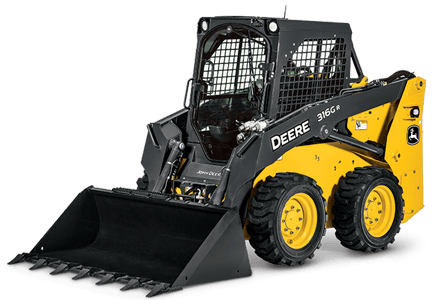
The John Deere 316GR is the high-power radial-lift machine in Deere’s small-frame G-Series skid steer lineup, sitting above the 312GR and 314G and beside the vertical-lift 318G. With 65 gross horsepower from a Yanmar diesel, a radial-lift boom, a 1,750 lb rated operating capacity, an optional two-speed transmission, and a 6,180 lb operating weight, it pairs the most power in the radial-lift class with the narrowest G-Series footprint. As of 2026, the 316GR remains in active production as part of Deere’s current small-frame lineup alongside the 312GR, 314G, 318G, and the 317G compact track loader.
This guide is built for Canadian buyers, not for brochure readers. You’ll find the full spec sheet, real Canadian used pricing, owner feedback, common reliability notes from operator forums and trade press, and a direct comparison against the machines you’re actually cross-shopping: Bobcat S66, Cat 246D3, Kubota SSV65, and the John Deere 318G.
Aglist quick take: The 316GR is the pick if you want maximum horsepower and travel speed in Deere’s narrow radial-lift small frame — 65 hp, optional two-speed, and a 62.9-inch width that still fits residential gates. Radial lift suits grading, digging, and backfill. Where it loses ground: radial-lift geometry isn’t ideal for loading over a truck box (the 318G’s vertical lift is), and rated operating capacity is roughly the same as the cheaper 314G — you’re paying for power and speed, not lift.
On This Page
ToggleQuick Verdict — Who the 316GR Is For
Buy it if: you run attachment-heavy work (augers, trenchers, brooms, snow blowers), move across larger sites and want two-speed travel, and value radial lift for grading and digging. The 65 hp Yanmar gives the strongest performance in the radial-lift class while keeping the narrow 62.9-inch width and half-ton trailerability. Ideal for landscapers and acreage operators who push the machine hard but don’t need vertical-lift truck loading.
Skip it if: your daily routine is loading pallets or material over the side of a pickup box (go vertical-lift 318G), or you mainly do light grading where the cheaper 314G’s similar lift capacity would save money. Also skip if soft, muddy, or snowy ground is your daily reality — the 317G track loader gives flotation and traction the wheeled 316GR can’t.
1. Full John Deere 316GR Specifications
Below is the consolidated spec sheet for the 316GR, sourced from John Deere’s official G-Series spec book and authorized dealer technical pages. Both metric and imperial values are listed for Canadian operators.
| Category | Spec | Value |
|---|---|---|
| Equipment type | Skid steer loader | Small-frame G-Series |
| Model designation | 316GR | |
| Engine | Manufacturer / model | Yanmar 4TNV86CHT, 4-cylinder turbo diesel |
| Emissions | EPA Final Tier 4 / EU Stage IV | |
| Gross power (ISO 14396) | 65 HP (48.5 kW) at 2,600 rpm | |
| Net power (SAE J1349) | 61 HP (45.6 kW) at 2,600 rpm | |
| Displacement | 2.1 L (128 cu. in.) | |
| Peak torque | 153 ft-lb (207 Nm) at 1,690 rpm | |
| Loader performance | Rated operating capacity (35%) | 1,750 lb (795 kg) |
| ROC with counterweight | 1,900 lb (863 kg) | |
| Tipping load | 3,500 lb (1,590 kg) | |
| Lift path | Radial | |
| Bucket breakout (foundry) | 5,250 lb (2,384 kg) | |
| Hydraulics | Standard auxiliary flow | 17 gpm (63 L/min) |
| High-flow option | ~30 gpm (112 L/min) | |
| System pressure | 3,450 psi (23,787 kPa) | |
| Quick-Tatch | Universal Quik-Tatch™ | |
| Travel | Drive | Hydrostatic; single-speed standard, two-speed optional |
| Travel speed (2-speed high) | up to 10.1 mph (16.3 km/h) | |
| Tires | Standard | 10 x 16.5 |
| Dimensions | Length without bucket | 103.0 in (2.63 m) |
| Width without bucket | 62.9 in (1,600 mm) | |
| Height to hinge pin | 115.1 in (2,920 mm) | |
| Weight | Operating weight | 6,180 lb (2,806 kg) |
| Controls | Standard | Manual foot-and-hand controls |
| Optional | EH joystick (ISO pattern) | |
| Fuel tank | Capacity | 19 gal (71 L) |
| Warranty (Canada) | Basic | 24 months / 2,000 hours |
Source: John Deere G-Series spec book and authorized Canadian dealer technical pages. Always confirm final configuration on the build sheet with your local John Deere dealer — control type (manual vs EH), two-speed option, high-flow hydraulics, cab vs ROPS, and cold-weather package all change the as-delivered configuration.
2. Owner Reviews & Ratings on Aglist
The 316GR has been on the Canadian market since 2017, so the field-hour base is mature. As Canadian owners share their experience on Aglist, the rating system tracks:
- Reliability — uptime, dealer warranty experience, fault-code patterns
- Performance — lift confidence, attachment compatibility, push power
- Comfort — cab noise (ROPS vs sealed cab), seat, HVAC
- Value for money — how it feels against new and used Canadian sticker
- Ease of maintenance — Quik-Tatch reach, swing-out rear door, cab tilt access
If you own or have operated a 316GR in Canada — whether it’s a 2017 ROPS unit on a hobby farm or a 2024 cab machine on commercial landscape work — please leave a star rating and a short note in the form below. Real operator feedback is what makes Aglist different from a brochure aggregator.
3. John Deere 316GR vs Competitors
The 316GR sits in the small-frame, 65–68 hp class as the radial-lift performance option. The machines you should actually be cross-shopping are:
| Spec | John Deere 316GR | Bobcat S66 | Cat 246D3 | Kubota SSV65 | John Deere 318G |
|---|---|---|---|---|---|
| Gross HP | 65 | 74 | 74.3 | 64.4 | 65 |
| ROC (35%) | 1,750 lb | 2,250 lb | 2,150 lb | 1,983 lb | 1,945 lb |
| Lift path | Radial | Vertical | Radial | Vertical | Vertical |
| Operating weight | 6,180 lb | 8,591 lb | 8,184 lb | 7,684 lb | 6,475 lb |
| Width (no bucket) | 62.9 in | ~66 in | ~66 in | ~66 in | 62.9 in |
| Two-speed | Optional | Optional | Optional | Optional | Optional |
| Aux flow (std) | 17 gpm | ~18 gpm | ~17 gpm | ~17 gpm | 17 gpm |
Where the 316GR wins: the narrowest, lightest 65 hp machine in the comparison — fits residential gates the wider Bobcat and Cat can’t, and stays half-ton trailerable. Optional two-speed travel and high-flow hydraulics extend its attachment range. Strong Deere dealer parts support across Canada. Radial lift is the right geometry for grading and digging.
Where it loses: the Bobcat S66 and Cat 246D3 are heavier machines with higher rated operating capacity and the leverage that comes with more weight. If maximum lift in the size class is the goal, the 316GR trails — its strength is power and speed in a narrow, light package, not raw capacity. For vertical-lift truck loading, the Deere 318G or the vertical-lift competitors are the better tools.
Real-world picking guide:
- Most power in a narrow, light radial-lift Deere → 316GR
- Vertical lift for truck loading in the same Deere frame → 318G
- Maximum lift capacity in the class → Bobcat S66 or Cat 246D3
- Soft-ground / winter traction → Deere 317G track loader
4. Real-World Performance
Lift Path & Loader Work
The 316GR uses a radial-lift boom. Radial lift arcs the load outward as it rises, giving more reach at mid-range heights — ideal for digging, grading, backfilling trenches, and spreading material. The trade-off versus the vertical-lift 318G is less reach and dump height at the very top of the cycle, so loading over the side of a tall pickup box is less comfortable. Within its intended ground-level and mid-height work, the 316GR’s extra horsepower means it sustains attachment performance and push power better than the lower-output 312GR and 314G.
Bucket breakout force around 5,250 lb (foundry bucket) is the strongest in the radial-lift small frame. The 65 hp Yanmar’s torque keeps the machine working hard through dense material where lower-output skid steers bog down.
Hydraulics & Attachment Capability
Standard 17 gpm auxiliary flow at 3,450 psi handles the full small-frame attachment list, and the optional high-flow package (~30 gpm) opens the door to demanding attachments — larger brooms, cold planers, and snow blowers that need more oil. The Universal Quik-Tatch™ is fast and reliable, and Deere has 100+ Worksite Pro attachments validated for this size class. The high-flow option is what separates the 316GR from the 312GR and 314G for attachment-heavy operators — if you run powered attachments hard, this is the radial-lift machine to specify.
Cab & Operator Experience
The 316GR is offered in open ROPS and enclosed cab configurations. The G-Series cab is roughly 25% larger in volume than the older E-Series, with a pull-down lap bar, deluxe instrumentation, and clear forward sightlines to the bucket cutting edge. Manual foot-and-hand controls are standard; EH ISO-pattern joysticks are optional, and on EH machines differential steering speeds up the outside wheel in turns for tighter maneuvering. Cab with heat and defrost is the right spec for Canadian winter work.
Travel & Undercarriage
The optional two-speed transmission lifts top travel speed to about 10.1 mph — a real productivity gain on larger sites where the machine spends time tramming between work areas. As a wheeled skid steer on 10 x 16.5 tires, the 316GR is faster and cheaper on running gear than a track loader, with the trade-off of less traction and flotation on soft ground, mud, and snow. On firm surfaces and finished work, the wheeled 316GR is the more efficient choice.
5. Common Problems & Reliability Notes
Transparency note: the items below are aggregated from operator forum threads, independent reviewers, and trade press. Not every 316GR will see these. Always confirm specific machine condition with a dealer pre-purchase inspection.
DEF / SCR system fault codes (general Final Tier 4 issue). Like every Final Tier 4 machine in this class, the 316GR’s Yanmar diesel uses DEF aftertreatment. DEF level sensors and SCR fault codes are documented across the platform — not unique to Deere. Mitigation: keep DEF fresh, never let the tank run fully empty, and pull fault history during used-machine inspection.
Tire wear and cost on hard surfaces. As a wheeled machine, the 316GR wears tires on abrasive surfaces — concrete, gravel, demolition debris. A replacement set of quality skid-steer tires in Canada runs several hundred to over a thousand CAD depending on type. Check tread and sidewall condition on used machines.
High-flow hydraulic system on hard-run machines. Machines specified with high-flow and run hard on demanding attachments show more wear on couplers, hoses, and hydraulic components. On used high-flow units, inspect the hydraulic system condition closely and review service history.
Battery and electrical wear on older units. Used 316GRs at 2,000+ hours commonly show corroded battery terminals, intermittent starter solenoid issues, and parking-brake sensor faults. Routine wear items, not platform-specific defects, but common pre-purchase findings on older machines.
No specific catastrophic-failure pattern documented. The Yanmar 2.1L Final Tier 4 diesel in the 316GR has a strong reliability reputation in operator discussions, with no high-profile pattern of injector or engine failures. The most common feedback is that the machine is mechanically straightforward and well-supported by the Deere dealer network.
6. Price Range in Canada (2025–2026)
Below are real Canadian dealer and used-listing reference bands. Final price depends on cab vs ROPS, control type, two-speed, high-flow, tire choice, attachments, and provincial tax.
New (2025–2026, Canada):
- New 316GR ROPS / manual-control configurations: typically CAD $68,000–$84,000 before tax
- New 316GR with cab, heat, EH controls, two-speed, high-flow: typically CAD $86,000–$105,000 before tax
- Promotional financing has been available at participating Canadian John Deere dealers through 2025–2026 — confirm current terms with your dealer
Used (2025–2026, AgDealer / Supply Post / MarketBook listings):
- 2018–2020 316GR with 800–2,500 hours, cab: CAD $46,000–$64,000
- 2021–2023 316GR with low hours (under 800 hrs): CAD $60,000–$80,000
- Older 2017 units or higher-hour machines: CAD $35,000–$50,000
7. Best Use Cases in Canadian Conditions
Commercial landscaping and grading (Ontario, Quebec, BC Lower Mainland, Maritimes). The 65 hp output and optional high-flow make the 316GR a strong attachment runner, while the 62.9-inch width still fits standard residential gates. Radial lift suits grading, soil spreading, and backfilling on demanding jobs.
Attachment-heavy property maintenance. Where lower-output skid steers bog down on powered attachments — large brooms, mulching heads, snow blowers — the 316GR’s horsepower and optional high-flow keep production up. This is its strongest argument over the cheaper 314G.
Hobby farm / acreage operations with demanding work. Just over 6,100 lb operating weight trailers behind any half-ton or larger pickup with appropriate trailer rating. The extra power handles heavier feed, bedding, and material tasks within the radial-lift capacity.
Light construction support across larger sites. The optional two-speed travel pays off on sites where the machine trams between work areas. Auger, trencher, breaker, and grading attachments cover most utility and prep work.
Snow removal (residential / light commercial). Strong push power for the size, and high-flow supports larger snow blowers. Snow pusher and angle plow attachments fit. Cab with heat is the right spec for Canadian winter operators. For the heaviest commercial snow with traction demands, a track loader is the better tool.
8. Maintenance & Service Intervals
The 316GR follows the standard small-frame G-Series service schedule. Below is the practical Canadian-climate summary — always check the operator’s manual for the authoritative schedule on your specific year and configuration.
- Every 10 hours (daily): engine oil level, hydraulic oil level, coolant, DEF level, air filter restriction indicator, tire condition, grease zerks per Quik-Tatch routing
- First 50 hours: initial engine oil and filter change, hydraulic return filter change, hardware torque check
- Every 250 hours: engine oil and filter, fuel filter check, in-cab HVAC filter
- Every 500 hours: primary and secondary fuel filters, hydraulic return filter, drive-chain inspection
- Every 1,000 hours: hydraulic oil change (or per fluid analysis), DPF inspection
- Every 2,000 hours: coolant flush, DEF system inspection
When John Deere Plus-50 II oil and a Deere oil filter are used, engine oil-change intervals can extend to 500 hours — worth confirming with your dealer.
Canadian winter add-ons: cold-weather starting package and block heater for sub -15°C starts (factory option, worth specifying on cab builds), winter-grade diesel discipline, DEF awareness (DEF freezes at -11°C but thaws in a heated tank — never dilute), and spare fuel filters on hand for cold-weather gel events.
The swing-out rear door and tilting hood make daily checks accessible at ground level, and a single person can lock the boom and tilt the operator’s station for drivetrain access in about two minutes.
9. Where to Buy the John Deere 316GR in Canada
The 316GR is sold and serviced through John Deere’s authorized Canadian dealer network — both Construction & Forestry dealers and many Ag & Turf dealers. Major dealer groups carrying small-frame G-Series inventory and parts in Canada include Brandt (Western Canada — the largest Deere CTL/skid-steer dealer network in Canada), Premier Equipment, Green Tractors, Huron Tractor, and Delta Power Equipment, among others.
Always ask your dealer for:
- Build sheet in writing before deposit (cab, controls, two-speed, high-flow, cold-start kit)
- Current promotional financing terms
- Extended warranty options (Machinery Scope or Deere extended coverage)
- Trade-in appraisal if applicable
- Local parts inventory confirmation
10. John Deere 316GR FAQ
How much horsepower does the John Deere 316GR have? 65 gross horsepower (48.5 kW) and 61 net horsepower (45.6 kW) from the Yanmar 4TNV86CHT 2.1L Final Tier 4 / EU Stage IV turbo diesel engine — the most powerful radial-lift machine in the small-frame G-Series.
What is the rated operating capacity of the 316GR? 1,750 lb (795 kg) at 35% tipping load, rising to 1,900 lb with counterweight. Tipping load is approximately 3,500 lb.
Does the 316GR have vertical or radial lift? Radial lift. The boom arcs outward as it rises, giving more reach at mid-range heights for digging, grading, and backfilling. For vertical-lift truck loading in the same frame, look at the 318G.
How much does a John Deere 316GR cost in Canada? New 316GR in Canada (2025–2026) ranges roughly from CAD $68,000 for ROPS / manual builds up to CAD $105,000 for cab / heat / EH / two-speed / high-flow configurations before tax. Used machines on AgDealer and Supply Post typically range CAD $35,000–$80,000 depending on year and hours.
Is the John Deere 316GR still in production? Yes. As of 2026, the 316GR remains in active production in Deere’s small-frame G-Series skid steer lineup, alongside the 312GR, 314G, 318G, and the 317G compact track loader.
What’s the difference between the 316GR and 318G? Both run the same 65 hp Yanmar engine, but the 316GR is radial-lift and the 318G is vertical-lift. The 318G’s vertical geometry gives more reach and dump height at the top of the cycle for truck loading, while the 316GR’s radial lift favours mid-height grading and digging. Choose by whether you load trucks or grade ground most.
What’s the difference between the 316GR and 314G? The 316GR has 65 hp versus the 314G’s 51 hp, plus optional two-speed travel and high-flow hydraulics. Lift capacity is similar, so the 316GR is the choice when you need power and speed rather than more lift.
Does the 316GR have high-flow hydraulics? High-flow hydraulics (~30 gpm) are available as an option on the 316GR, supporting demanding powered attachments. The 312GR and 314G do not offer high-flow.
Is the 316GR good for snow removal in Canada? Yes for residential and light commercial snow, and high-flow supports larger snow blowers. Cab with heat is the right spec for winter operators. For the heaviest traction-demanding snow contracts, a track loader is the better tool.
Where can I read real owner reviews of the 316GR? On this page, in the Reviews & Ratings section below. Aglist publishes operator-submitted reviews of the 316GR from Canadian owners — leave yours to help the next buyer.
11. Related Models on Aglist
- John Deere 318G — vertical-lift version, same 65 hp frame, for truck loading
- John Deere 314G — lower-power radial-lift skid steer, one step down
- John Deere 312GR — entry small-frame skid steer
- John Deere 317G — compact track loader version for soft ground and winter traction
- Kubota SSV65 — primary Kubota competitor in this class
- John Deere G-Series — full small-frame lineup overview
Disclaimer
All specifications sourced from John Deere’s official G-Series spec book and authorized dealer technical pages, supplemented by independent equipment spec guides. Pricing collected from Canadian listings on AgDealer, Supply Post, and MarketBook between 2025 and 2026; actual transaction prices vary by configuration, financing program, trade-in, and province. Reviews on Aglist are written by real users and moderated for spam — opinions are personal. Always confirm critical specifications and service history with your dealer and the operator’s manual before purchase, service, or repair.
12. John Deere 316GR Reviews & Ratings
Share your experience
Help other Canadian buyers — leave a quick review for the
John Deere 316GR
There are no reviews yet. Be the first one to write one.