
Overview & Specs
GT 245XL Grain Dryer Review, Specs & Buyer’s Guide — Canada
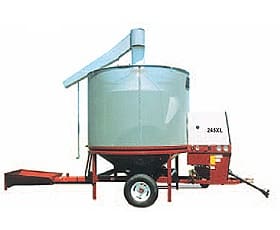
The GT 245XL is the entry point into GT Manufacturing’s recirculating batch grain dryer lineup — the smallest current-production model, built for small farms, hobby operations, and anyone wanting a simple, PTO-driven way to dry grain on-farm without a large capital outlay. With a 200-bushel batch capacity, a drying rate of 140 bu/h (at 5 points of moisture removal), a 2.2-million-BTU burner, and a tractor-powered design, it represents the most affordable route into GT’s proven batch-drying approach. GT Manufacturing has built batch dryers since 1953 and positions itself as a worldwide leader in the recirculating batch field.
This guide is built for Canadian buyers, not brochure readers. You’ll find the full official spec sheet, real Canadian pricing context, how the recirculating batch process works, common ownership notes, and how the 245XL compares to the larger GT models you might cross-shop as your needs grow.
Aglist quick take: The 245XL is the simplest, lowest-cost entry into on-farm batch drying — PTO-driven, 200 bu batch, ideal for small acreage and hobby farms. Its strength is simplicity and low cost of entry; a batch dryer like this pays for itself quickly on a small operation. Where it’s limited: batch (not continuous) drying means lower total throughput, and at 140 bu/h it’s sized for modest daily volumes. If your production grows, the GT line scales up to the 350-bu 300/345XL and beyond.
On This Page
ToggleQuick Verdict — Who the GT 245XL Is For
Buy it if: you run a small farm or hobby operation, want a simple PTO-driven batch dryer at the lowest entry cost in the GT range, and your daily drying volume is modest. The 200-bushel batch and 140 bu/h rate suit small grain volumes, and the recirculating design dries evenly with minimal complexity.
Skip it if: you have larger daily volumes that would make batch cycling a bottleneck (step up to the 300, 345XL, or the RB and RAB models), or you need continuous-flow throughput — in which case a GSI tower, NECO mixed-flow, or used continuous machine fits better.
1. Full GT 245XL Specifications
Sourced from GT Manufacturing’s official specifications. Confirm final configuration with your dealer.
| Category | Spec | Value |
|---|---|---|
| Type | Dryer design | Recirculating batch |
| Drying capacity | At 20.5–15.5% (5 pts) | 140 bu/h (3.5 t/h) |
| Bushel capacity | Batch | 200 bu (6.6 tonne) |
| Burner | Max output | 2,200,000 BTU/h (645 kW) |
| Fan | Type | 26″ axial |
| Rating | 10,800 CFM @ 1.5″ SP | |
| Power | PTO speed | 475 rpm |
| Electric motor (option) | 20 HP, 1,750 rpm (14.9 kW) | |
| Recirculating time | 5–7 min | |
| Augers | Loading/unloading rate | 2,000 bu/h each |
| Loading auger | 8″ | |
| Vertical auger | 12″ | |
| Dimensions | Diameter of bin | 8 ft (2.4 m) |
| Height to top of auger | 13 ft 6 in | |
| Overall length | 13 ft 4 in | |
| Weight | PTO model | 2,900 lb (1,318 kg) |
| Fuel | Propane (vaporizer included) | |
| Warranty | 2-year limited |
Source: GT Manufacturing official model specifications. Standard equipment includes loading hopper, two tires, manual unloading head, circulating auger, PTO tumbler shaft, dryer controls with grain sampler, four jack stands, vaporizer, ladder, and fan clutch.
2. How the Recirculating Batch Process Works
A recirculating batch dryer works differently from a continuous-flow tower or mixed-flow machine. Grain is loaded into the dryer’s bin as a batch, where a circulating auger continuously moves the grain up and around while a fan forces heated air through it. Because the grain is constantly recirculated past the heat, it dries evenly — every kernel passes through the drying zone repeatedly rather than sitting in one spot. Once the batch reaches target moisture, it’s unloaded, and the next batch is loaded.
The advantage is simplicity and even drying in a low-cost, often PTO-driven package — no complex metering systems, no screens, and a tractor provides the power. The trade-off versus continuous-flow is total throughput: you dry one batch at a time, so daily volume is limited by batch size and cycle time. For the 245XL, the 200-bushel batch and 5–7 minute recirculating time make it well-suited to small operations where simplicity and low cost matter more than maximum bushels per hour.
3. Owner Reviews & Ratings on Aglist
As Canadian owners share their experience on Aglist, the rating system tracks reliability, drying capacity in real conditions, fuel efficiency, ease of operation, and serviceability. If you own or have run a GT 245XL in Canada, please leave a star rating and a short note below — owner data on batch dryers is scarce online, and your experience helps the next small-farm buyer.
4. How the GT 245XL Compares
The 245XL is the smallest in GT’s batch lineup. Here’s how it frames against its nearest GT siblings.
| Spec | GT 245XL | GT 300 | GT 345XL |
|---|---|---|---|
| Drying capacity | 140 bu/h | 235 bu/h | 235 bu/h |
| Batch capacity | 200 bu | 350 bu | 350 bu |
| Burner | 2.2M BTU | 2.2M BTU | 2.2M BTU |
| Fan | 26″ axial | 33″ centrifugal | 26″ axial |
| Recirc time | 5–7 min | 5–7 min | 10–12 min |
| Weight (PTO) | 2,900 lb | 2,900 lb | 3,350 lb |
Where the 245XL wins: lowest cost and lightest machine in the GT range, simplest to operate, ideal for the smallest operations. Where it’s outgrown: as daily volume rises, the 300 (same weight, larger 350-bu batch and 33″ centrifugal fan for faster drying) or the 345XL offers more capacity. For the full lineup, see the GT grain dryers hub.
5. Real-World Performance
The 245XL’s 140 bu/h rate at 5 points of removal is modest by design — it’s the small-farm machine. The 26″ axial fan moves 10,800 CFM, and the short 5–7 minute recirculating time means batches cycle quickly for the size. For small grain volumes, hobby farms, and operations drying for on-farm storage or local sale, it does the core job simply and affordably. The PTO drive means no three-phase power requirement — a tractor runs it, which suits remote yards.
6. Common Problems & Reliability Notes
Transparency note: these are general batch-dryer ownership considerations, not model-specific defects. Confirm condition on any used machine.
Batch dryers like the 245XL are mechanically simple, which works in their favour for reliability. Common ownership points across the type: keep the circulating auger and drive in good order (it’s the heart of even drying), maintain the burner and vaporizer per the manual, check the fan clutch and belt, and confirm the PTO driveline is in good condition on used units. Propane discipline matters in cold prairie conditions. No high-profile catastrophic failure pattern is associated with the GT batch line — the simplicity is the reliability story.
7. Price Range in Canada
The 245XL is the lowest-cost GT dryer. New pricing varies by dealer, configuration (PTO vs electric motor option), and province — contact a Canadian GT dealer for a current quote. On the used market, GT batch dryers (including older Tox-O-Wik models) appear regularly on AgDealer, Ritchie Bros, and BigIron at accessible prices, making a used GT a low-cost entry into on-farm drying. GT notes its dryers hold high resale value and often pay for themselves in 1–3 years on a working operation.
8. Best Use Cases in Canadian Conditions
Small prairie farms and hobby operations (SK / AB / MB). The 200-bushel batch suits modest daily volumes and on-farm storage drying. Remote yards without three-phase power. PTO drive runs off a tractor. Operations drying for local sale or home storage. Simple, affordable, even drying. Not ideal for: larger daily volumes (step up the GT range) or operations needing continuous-flow throughput.
9. Maintenance & Service
- Maintain the circulating auger and drive — central to even drying
- Service burner and vaporizer per the manual; propane discipline in cold weather
- Check fan clutch, belt, and PTO driveline regularly
- Inspect grain sampler and controls each season
- Keep a ULC-approved fire extinguisher with the dryer
GT provides manuals, technical tips, and parts ordering through its dealer network. For the full GT range and buying guidance, see the GT grain dryers hub.
10. GT 245XL FAQ
How much grain can a GT 245XL dry? 140 bu/h at 5 points of moisture removal (20.5–15.5%), with a 200-bushel batch capacity. Actual throughput depends on crop, starting moisture, and conditions.
Is the 245XL PTO or electric? PTO-driven as standard (475 rpm), with an optional 20 HP electric motor. The PTO drive suits yards without three-phase power.
What’s the difference between the 245XL and 300? Both share the same 2.2M BTU burner and 2,900 lb weight, but the 300 has a larger 350-bushel batch and a 33″ centrifugal fan (vs the 245XL’s 26″ axial), giving more capacity. The 245XL is the lower-cost, smaller-volume option.
Is the GT 245XL good for canola? Batch dryers handle canola, but set temperatures carefully for the crop. Confirm settings with GT documentation and your dealer for canola drying.
Is the 245XL still made? Yes — it’s the entry model in GT Manufacturing’s current recirculating batch lineup.
11. Related Models on Aglist
- GT 300 — next step up, 350-bu batch, centrifugal fan
- GT 345XL — 350-bu batch, axial fan, taller plenum
- GT 545XL — larger 500-bu batch machine
- GT Grain Dryers Compared — full GT lineup hub
- NECO Mixed-Flow Dryers — continuous-flow alternative
- Best Grain Dryers in Canada — full buyer’s guide
Disclaimer
Specifications sourced from GT Manufacturing’s official model pages. GT notes specifications are subject to change without notice. Pricing varies by dealer, configuration, and province. Reviews on Aglist are written by real users and moderated for spam — opinions are personal. Always confirm specifications and configuration with your GT dealer and the owner’s manual before purchase, service, or repair.
12. GT 245XL Reviews & Ratings
Share your experience
Help other Canadian buyers — leave a quick review for the
GT 245XL
There are no reviews yet. Be the first one to write one.


